When your low back hurts, it makes sense to focus on your back.
But here's something that may surprise you: sometimes your hips are an important part of the evaluation too.
That doesn't mean your hip is necessarily “causing” your back pain.
It means your low back and hips work together every time you walk, bend, squat, climb stairs, lift something, swing a golf club or get up from a chair.
If one area has limited motion, reduced strength, poor endurance or simply isn't tolerating the demands being placed on it, the way you move can change.
Your hips and back share a job
Think about picking something up from the floor.
Your hips need to move.
Your knees need to move.
Your spine needs to move and control the position of your trunk.
Your muscles need to produce and control force.
That's a coordinated task.
It's rarely useful to look at one body part completely by itself.
This is why a back evaluation may include hip mobility, hip strength and functional movements even when your main complaint is in your lower back.
Does tightness in your hips cause back pain?
Not automatically.
“Your hips are tight, so that's why your back hurts” is an appealingly simple explanation.
Real bodies aren't always that simple.
Some people with back pain have limited hip mobility. Others don't.
Some people have strength or endurance limitations. Others have plenty of strength but struggle with a particular movement or activity.
And some people have back pain without an obvious hip limitation at all.
The important question is whether a particular finding is actually relevant to your symptoms and your function.
What happens when your hip doesn't move the way you need it to?
Your body still has to complete the task.
If you're squatting and your hips don't provide the movement you need, you may change how you use your knees, ankles or spine.
If you're walking and your hip doesn't extend comfortably, other parts of the movement may change.
That doesn't mean the resulting movement is automatically “bad.”
Your body is constantly finding ways to accomplish a task.
The clinical question is whether the strategy is contributing to your symptoms, limiting your performance or preventing you from doing what you want to do.
This is where a movement assessment helps
Rather than assuming the hip is the problem, a clinician can compare:
- Hip mobility
- Lumbar mobility
- Strength
- Balance and control
- Functional movements
- Your symptom response
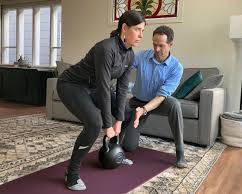
For example, if your back hurts when you squat, we may want to see what happens when you change the depth, stance, hip movement or load.
We're looking for patterns.
Your goals change what matters
A recreational golfer may need a different hip assessment than someone who wants to walk comfortably around the neighborhood.
A runner needs enough hip motion and strength to tolerate repetitive impact.
Someone who lifts weights needs to control the hip and trunk under progressively heavier loads.
The same diagnosis doesn't automatically create the same rehabilitation plan.
The takeaway
Looking at your hips when you have back pain doesn't mean we're blaming your hips.
It means we're trying to understand how your entire movement system is working.
Your back, hips and lower extremities all contribute to the things you want to do.
If your back pain keeps interfering with those activities, a movement-based evaluation can help determine whether your hips are relevant to the picture — and, just as importantly, whether they aren't.