When your knee hurts, you want to know what's wrong with it. That's reasonable. A good evaluation should examine the knee rather than skip over it.
But sometimes the most useful assessment includes more than the painful area.
Walking, squatting, climbing stairs, and running involve the coordinated movement of several joints and muscle groups. Looking at how you perform these tasks can help a clinician understand which factors may be relevant to your symptoms.
Start with the knee, then consider the whole task
A knee evaluation may include your symptoms, medical history, swelling, range of motion, strength, and tolerance for weight-bearing.
The clinician may ask whether the pain started suddenly or gradually, where you feel it, what makes it worse, and whether you experience locking, instability, or other symptoms.
Those details help determine what conditions should be considered and whether further medical assessment or imaging may be appropriate.
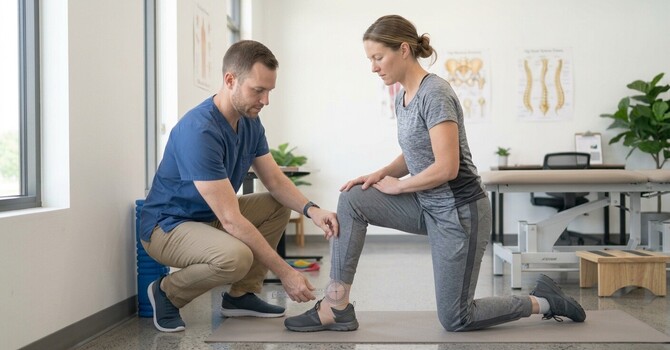
The evaluation may then include the hip, ankle, and foot, especially when movement testing suggests they could influence the task that causes pain.
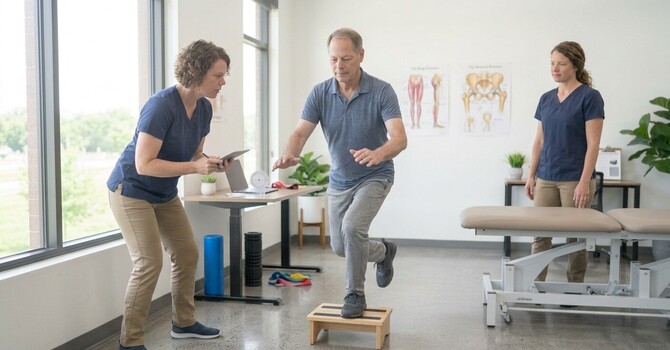
For example, hip strength may be relevant when knee symptoms appear during repeated single-leg activities. Ankle mobility may be worth examining when a limitation changes how someone performs a squat. But neither finding automatically explains the pain.
Movement gives us information
Imagine two people with knee pain during stairs.
One has discomfort around the kneecap, with symptoms reproduced during squatting and step-downs. The other has substantial swelling and a history of the knee twisting during sport.
They shouldn't automatically receive the same assessment or plan. Their symptoms and history raise different questions.
A functional examination can help identify which movements reproduce symptoms, how much activity the person tolerates, and whether there are limitations in strength, balance, or mobility. The results are interpreted alongside the history and other clinical findings, not in isolation.
The goal isn't to find fault with how someone moves. There is no single perfect way to perform every task, and a movement difference doesn't necessarily cause pain.
Why this matters for treatment
If a person's main limitation is reduced strength and tolerance for stairs, an appropriately progressed strengthening plan may be useful. If the examination identifies a mobility limitation that affects the task, that may deserve attention too.
If symptoms suggest a significant injury or another condition outside the scope of conservative musculoskeletal care, the appropriate next step may be medical referral.
Treatment should follow the findings rather than a preset formula. It should also change as the patient improves, tolerates more activity, or develops new information.
What do you want your knee to do again?
A meaningful evaluation connects clinical findings to real life. Are you trying to return to running? Get through a work shift? Play with your children? Lift weights? Walk on vacation without worrying about the next staircase?
Those goals help guide which activities should be assessed and how progress should be measured.
At Optimal Health, a functional approach looks at the painful area and the broader movement demands that matter for you. The aim is to understand the problem as clearly as possible and use that understanding to guide individualized care.
CTA: If knee pain is limiting the things you want or need to do, schedule an evaluation to discuss your symptoms, your goals, and which findings may help guide your next steps.