If your heel hurts, should you stretch your calf or work on ankle mobility?
Sometimes those approaches are relevant. But limited ankle movement isn't automatically the cause of heel pain, and improving mobility isn't always the first priority.
The useful question is whether your ankle's available movement affects the activities that provoke your symptoms.
What does ankle mobility have to do with walking?
One important ankle movement is dorsiflexion, which allows your shin to move forward over your foot while your foot remains on the ground.
You use this movement when walking, descending stairs, and moving through a squat. The ankle, foot, and calf muscles work together as you accept weight and move forward.
If ankle movement is limited, you may adjust how you perform these tasks. That can be relevant to an assessment of foot function, but it does not prove that the restriction caused pain in the heel.
People vary naturally in their range of motion. What matters is whether your available movement is adequate for the tasks you need to perform and whether the findings fit your symptoms.
Why might ankle motion be limited?
Previous ankle sprains, swelling, joint stiffness, calf flexibility, or a period of reduced activity can affect ankle movement.
Sometimes a person feels tight around the back of the ankle even though the actual range of motion is adequate. Stretching harder may not address the reason for that sensation.
Heel pain also has several possible causes. A clinician should assess the heel itself rather than assuming that the ankle explains everything.
How can an evaluation help?
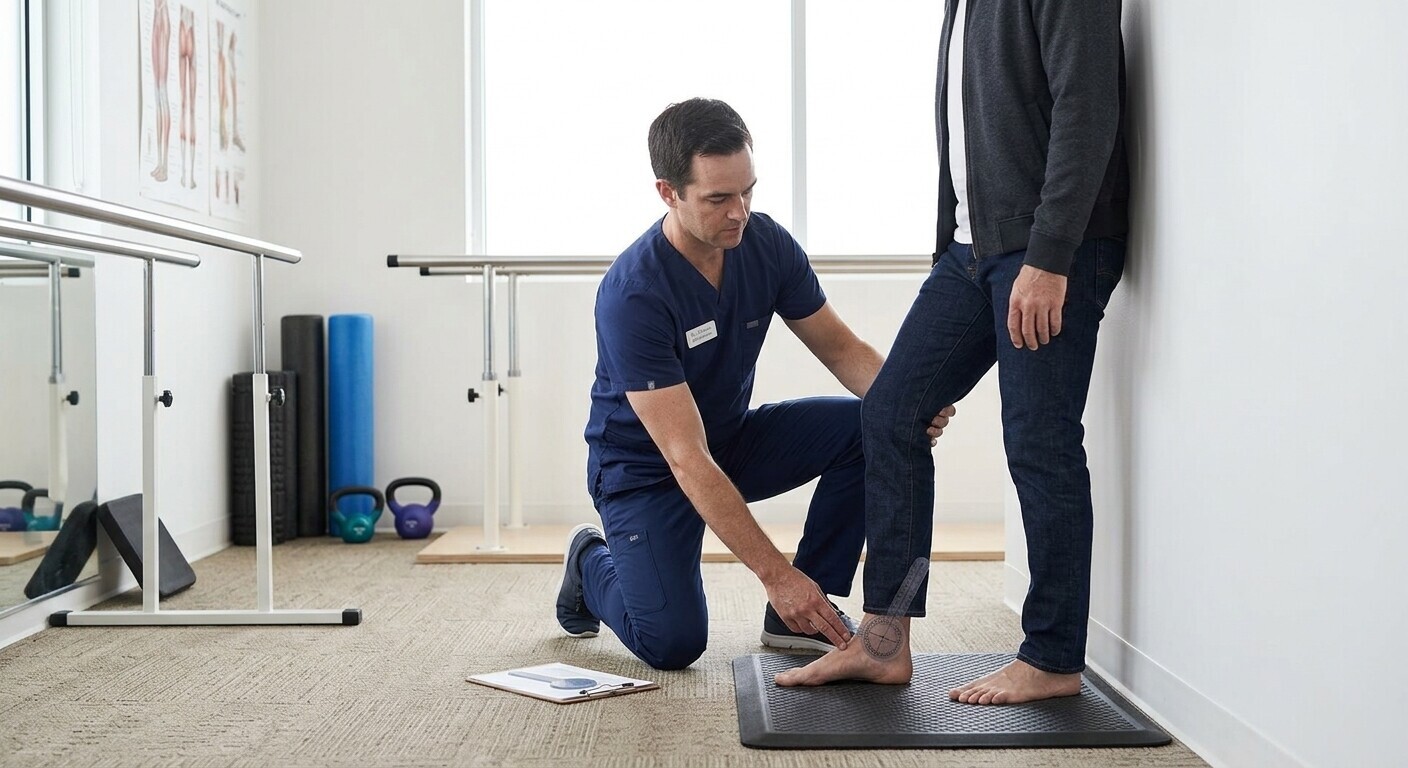
A clinician may assess ankle dorsiflexion, calf strength, foot movement, and the way you walk or perform a step-down. Your symptoms, injury history, and activity demands help determine which findings are relevant.
If a meaningful mobility restriction is present, appropriate calf or ankle mobility work may be included in the plan. If mobility is adequate, attention may instead focus on strength, load tolerance, or another cause of heel pain.
The response to a movement modification can provide useful information, but no single test establishes the cause by itself.
Stretching should have a purpose
For plantar fasciitis, calf stretching and plantar fascia-specific stretching are supported components of care. However, these approaches should fit the individual presentation and be combined with other appropriate strategies, such as strengthening and activity management.
If stretching increases your pain substantially, don't keep forcing it. Persistent, worsening, or unusual heel pain warrants reassessment.
At Optimal Health, the goal is to identify whether ankle mobility is actually relevant to your symptoms and build a plan around your functional needs rather than stretching every tight-feeling area.
CTA: If heel pain and ankle stiffness are limiting your walking or exercise, schedule an evaluation to determine whether mobility is a meaningful factor and what should be addressed first.