It happens again.
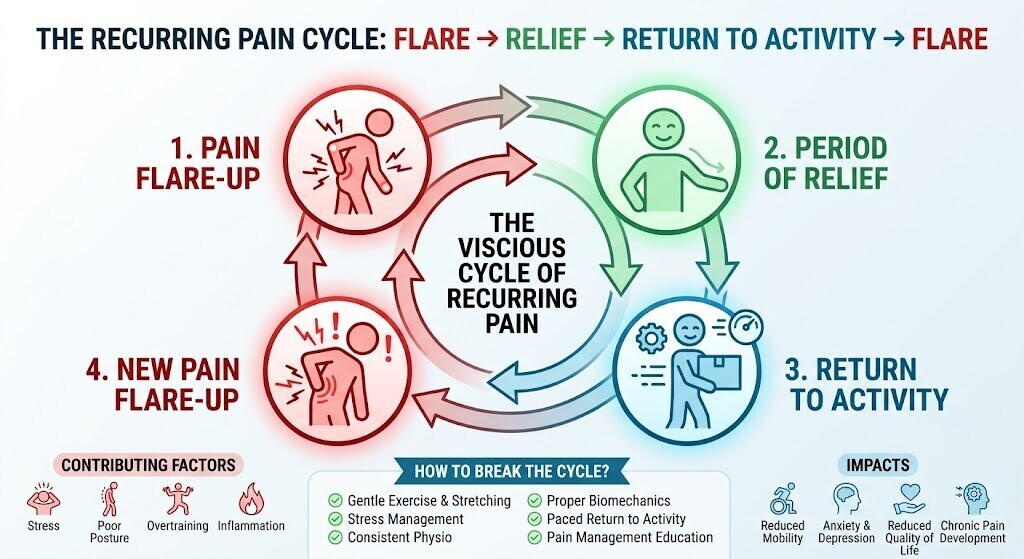
Your back starts hurting.
You get through it.
Eventually, you feel normal.
A few months go by.
Then the same thing happens all over again.
If you're stuck in that cycle, it's understandable to wonder why your back keeps “going out.”
But recurring back pain doesn't necessarily mean your spine is repeatedly being damaged.
Often, the more useful question is:
What happens between episodes?
Feeling better isn't always the same as being ready
Pain can improve before your strength, endurance or activity tolerance are fully rebuilt.
That's one reason people sometimes feel great for a few weeks and then flare up when life gets busy again.
They return to their normal activities.
They feel fine.
Then they suddenly do more lifting, more golf, more yard work, more exercise or more travel than their current capacity can handle.
The pain returns.
Look at what changed
When your symptoms come back, think about the weeks leading up to the flare.
Did your activity increase?
Did you stop exercising?
Did you change your workout?
Start playing golf again?
Take on a new project at work?
Travel?
Spend more time sitting?
Sleep poorly?
Have several stressful weeks?
There may not be one single answer.
But identifying changes in your routine can provide useful clues.
The body adapts to what you ask it to do
If you stop lifting for six months, your body isn't going to have exactly the same lifting capacity you had when you were training consistently.
If you stop running, your running tolerance changes.
If you stop exercising after your back feels better, your strength and conditioning may gradually decline.
That's not failure.
It's normal adaptation.
The challenge is recognizing that your current capacity may not match your previous activity level.
This is why “just stretch it” isn't enough
Stretching may help you feel better.
Hands-on treatment may help.
An adjustment may help.
But if your back repeatedly flares when you return to a certain activity, symptom relief alone may not address the bigger issue.
You may need to rebuild strength.
Improve endurance.
Increase mobility where appropriate.
Practice movement.
Gradually increase load.
And eventually return to the activities that tend to expose the problem.
Reassessment matters
If the same problem keeps returning, it's worth reassessing rather than automatically repeating the exact same treatment.
Your presentation may have changed.
Your activity level may have changed.
Your goals may have changed.
The thing that helped during the original episode may not be the thing you need now.
That's one reason a good rehabilitation plan should evolve.
What does long-term success look like?
It isn't necessarily never feeling a twinge in your back again.
Human bodies hurt sometimes.
A more useful goal is increasing your ability to handle life's demands without every flare turning into a major setback.
Maybe you can golf 18 holes without your back tightening up.
Maybe you can lift your kids comfortably.
Maybe you can work a full day without needing to lie down afterward.
Maybe you can return to the gym and gradually increase the weight again.
That's capacity.
Don't wait for the next flare
If your back pain has become a repeating cycle, you may benefit from looking at the bigger picture while you're feeling relatively good.
What are your current movement limitations?
How strong are you?
How much endurance do you have?
What activities trigger symptoms?
What are you trying to get back to?
Those questions can help create a plan that isn't based solely on what hurts today.
At Optimal Health, the goal isn't simply to help you feel better until the next episode.
We want to understand the movement and capacity demands behind your symptoms and help you build toward the activities you want to keep doing.
Because getting out of pain is valuable.
Being able to trust your body again is even better.