You start the workday feeling fine.
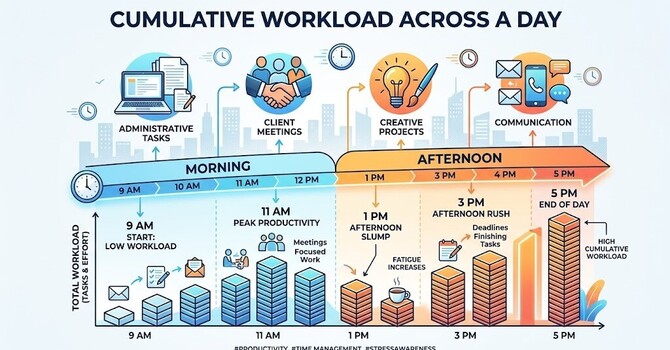
A few hours later, your low back feels stiff.
By lunchtime, you're shifting around in your chair.
By 4 p.m., you're ready to stand up and walk around just to get some relief.
If that sounds familiar, you're not alone.
But the explanation probably isn't as simple as “sitting is bad for your back.”
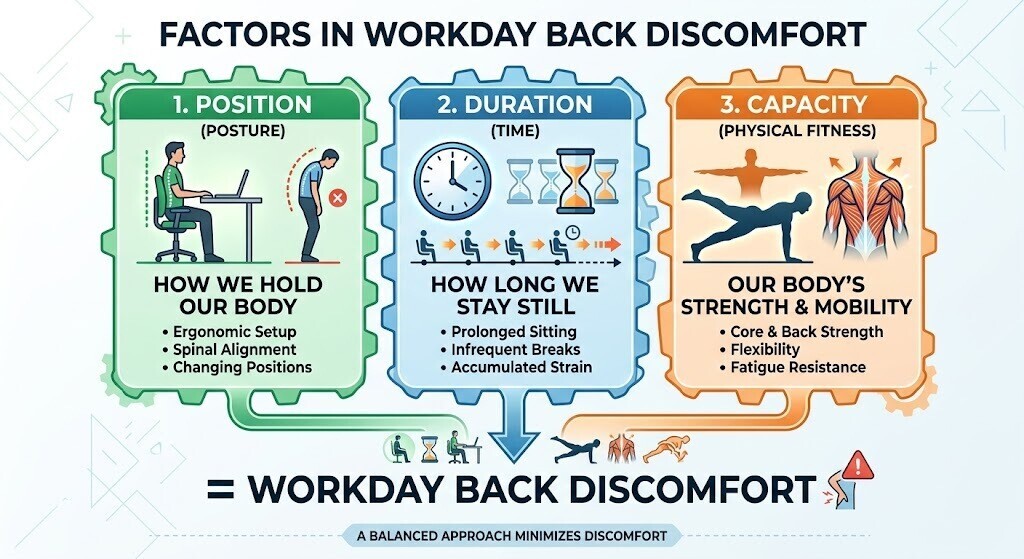
Your body isn't designed around one perfect position. What often matters more is how long you're in a position, how often you move, your overall physical capacity, and how demanding your workday is.
Sitting isn't automatically the problem
Sitting is a normal human activity.
The problem is that many desk jobs require you to sit for hours with very few changes in position.
Your body may tolerate 20 minutes of sitting without a problem but feel very different after three or four uninterrupted hours.
That doesn't mean you've damaged your spine.
It may simply mean you've exceeded your current tolerance for that particular activity.
Why does your back feel stiff?
There are several possibilities.
You may be staying in one position for too long.
You may have reduced your overall activity level.
Your hips and spine may not be tolerating the position comfortably.
You may have recently increased your workload.
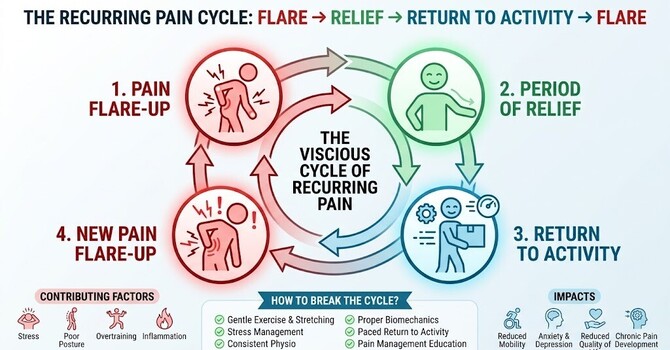
Or you may simply be experiencing a flare of an existing back problem.
That's why telling everyone with desk-related back pain to “sit up straight” isn't enough.
Do you need perfect posture?
Probably not.
There isn't one posture that you need to hold perfectly for eight hours.
In fact, trying to maintain an ideal position all day can become its own source of fatigue.
A better goal is to have options.
Sit.
Stand.
Walk.
Change your chair position.
Move your hips.
Take a brief break.
Return to your task.
Your next position may be more useful than your perfect position.
What can you try during the workday?
Start simple.
Change positions regularly rather than waiting until your back is already irritated.
Take short walking or movement breaks.
Adjust your workstation so that you're comfortable.
Use a sit-to-stand option if your workspace allows it.
And, most importantly, keep some physical activity in your life outside of work.
A five-minute movement break won't compensate for every possible contributor to back pain, but it can be one practical way to reduce prolonged inactivity.
What if movement doesn't help?
That's useful information too.
If your back consistently hurts during or after sitting, pay attention to the pattern.
Does standing help?
Does walking help?
Does bending change the symptoms?
Does the pain travel into your leg?
Are you experiencing numbness or tingling?
Those details can help distinguish ordinary workday stiffness from a presentation that deserves a more specific evaluation.
Your desk job isn't your diagnosis
Two people can sit at the same desk for eight hours and have completely different experiences.
One may have no symptoms.
Another may develop significant back pain.
That difference is one reason we don't want to blame the chair, the desk or posture alone.
Your previous injuries, activity level, strength, mobility, sleep, workload and many other factors can influence how you tolerate a workday.
The goal is a back that can handle your life
If you have to sit for work, the solution can't simply be “stop sitting.”
The goal is to improve your ability to tolerate the activities your life requires.
That may involve movement changes during the workday, exercise, progressive strengthening, mobility work or other individualized strategies.
If your back pain repeatedly interferes with your workday, an evaluation can help determine whether the issue is primarily related to movement tolerance, physical capacity, an underlying musculoskeletal problem or something else.
You shouldn't have to spend every afternoon fighting with your chair.