You get through your workday without much trouble.
Then you get home.
You sit down for dinner and realize your low back hurts.
Maybe you feel stiff.
Maybe you notice an ache.
Maybe the symptoms don't really show up until you're finally done working.
That can be confusing.
If your back didn't hurt while you were working, why does it hurt afterward?
Pain doesn't always appear at the exact moment of the demand
Your body doesn't necessarily send you a pain signal the second you've exceeded a particular threshold.
Symptoms can build over time.
Think about physical fatigue.
You may feel fine during the first hour of yard work.
By the third hour, you're tired.
Your movement changes.
Your back feels more noticeable.
The same basic principle can apply to other activities.
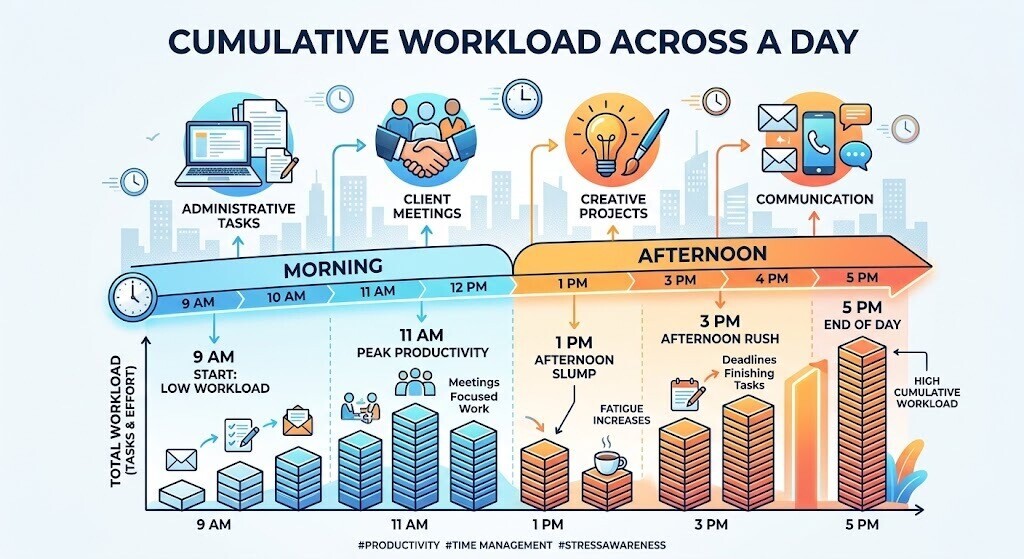
The day's total workload matters
Your back doesn't experience your workday as seven or eight completely separate hours.
Your body experiences the accumulated demand.
Maybe you sat for most of the morning.
Then you walked around the building.
Then you lifted something.
Then you drove home.
Then you mowed the lawn.
Then you picked up your kids.
The individual tasks may each seem manageable.
Together, they may exceed what your body is currently prepared to tolerate.
This is where capacity becomes important
Capacity is your ability to tolerate a particular physical demand.
If the demands of your life are consistently greater than your current capacity, symptoms may show up.
That doesn't necessarily mean you're fragile.
It may simply mean your capacity needs to catch up with your lifestyle.
That's where progressive exercise and rehabilitation can be valuable.
Why does rest sometimes make it feel better?
Because reducing the demand gives your body an opportunity to recover.
That's useful.
But if every flare leads to several days of complete rest, you may never build the capacity needed to tolerate the original activity.
The goal is usually not “rest forever.”
It's finding an appropriate level of activity and gradually progressing from there.
Could your movement be part of the picture?
Possibly.
A clinician may look at how you squat, hinge, walk, lift or perform other tasks.
But the goal isn't to identify one movement and declare it the cause.
It's to see whether a particular movement limitation or control issue is actually relevant to your symptoms and function.
What about strength and endurance?
Both can matter.
You may have enough strength to perform a task once but not enough endurance to repeat it all day.
That's why rehabilitation may need to progress beyond isolated exercises.
Eventually, the exercises need to prepare you for the actual demands of your work and life.
Your workday can become part of your rehabilitation plan
If your symptoms consistently appear at the end of a workday, tell your clinician.
That's valuable information.
It may change what gets assessed.
It may change the exercises selected.
It may change how your activity is progressed.
It may even change how you structure your workday.
The goal is to create a plan that fits your actual life rather than asking you to live around a rehabilitation program.
You shouldn't have to choose between work and your back
If you're consistently finishing the day with pain, don't assume it's simply something you have to accept.
And don't assume it means your back is being damaged every day.
There may be a gap between what your body can currently tolerate and what your job requires.
A thoughtful evaluation can help identify that gap and create a plan to close it.