If you've ever felt pain shoot from your low back or buttock into your leg, you may have wondered, “Is this sciatica?”
It's a reasonable question.
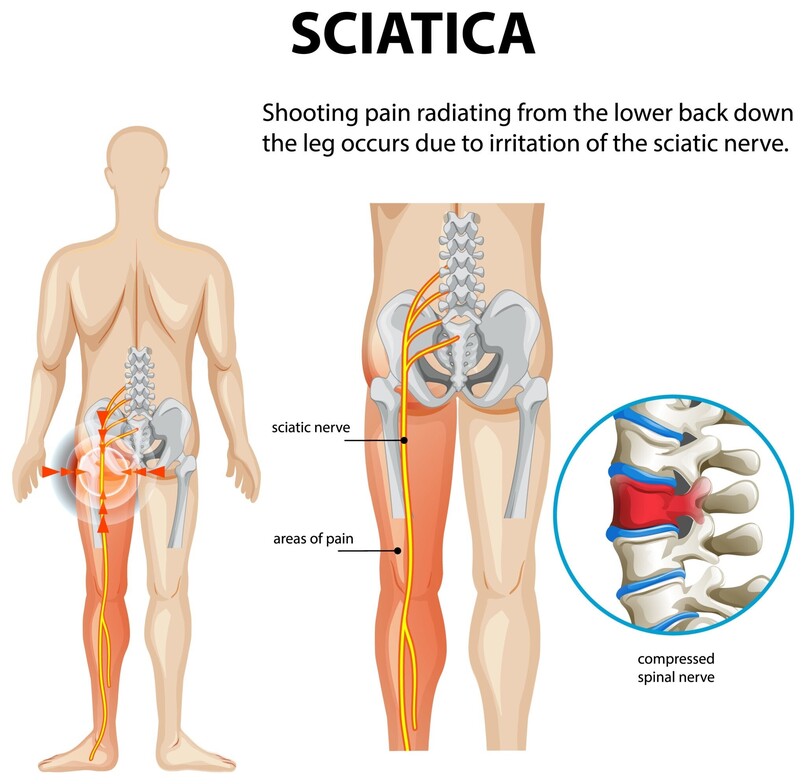
The word “sciatica” gets used a lot, but it isn't simply another name for back pain. It describes a pattern of symptoms involving the lower back and leg, commonly related to irritation or pathology involving the lumbosacral nerve roots.
To understand why that can happen, it helps to understand the sciatic nerve.
What is the sciatic nerve?
The sciatic nerve is a large nerve that ultimately supplies much of the lower leg and foot.
It is formed from several nerve roots that come from the lower portion of your spine. Those nerve roots join together and travel through the pelvis and buttock before continuing down the leg.
That long pathway is one reason symptoms related to the lower spine can sometimes be felt far away from the low back.
You might feel symptoms in your buttock, back of the thigh, calf or foot even though the problem affecting the nerve is closer to your spine.
What does sciatica feel like?
People can experience sciatica differently.
Some describe sharp or shooting pain.
Others notice burning, tingling, numbness or an aching sensation.
Some people experience several of these symptoms at the same time.
You may also notice that certain positions or activities change the symptoms.
Sitting might aggravate them. Walking might feel better. Bending might make them worse. Or you may notice the exact opposite.
That symptom behavior is useful information.
Sciatica isn't just “a tight muscle”
It's common to assume that pain traveling down the leg must be a tight hamstring, glute muscle or hip problem.
Sometimes muscles can certainly contribute to symptoms around the hip and leg.
But when symptoms follow a nerve-related pattern, the nervous system deserves attention.
That's why a good evaluation may include strength, sensation, reflexes, movement and symptom behavior rather than simply stretching the painful area.
Does sciatica always mean something is seriously wrong?
No.
The word itself doesn't tell us how severe the underlying problem is.
It also doesn't mean you automatically need an MRI or surgery.
NICE recommends against routinely offering imaging for low back pain with or without sciatica in a non-specialist setting. Imaging is generally considered when the result is likely to change management.
That doesn't mean imaging is never useful. It means the decision should be based on the individual clinical picture.
What should you do if you have symptoms down your leg?
Pay attention to the pattern.
What makes the symptoms better?
What makes them worse?
Are they changing?
Are you developing numbness or weakness?
And what activities are becoming difficult?
A clinician can use those details to determine what needs to be examined and whether conservative care is appropriate.
At Optimal Health, the goal isn't simply to label your symptoms “sciatica.” It's to understand how your back, nervous system and movement are interacting and then build a plan around what you actually need to get back to doing.
If leg symptoms are interfering with your work, exercise, sleep or normal activities, an individualized evaluation can help clarify what you're dealing with and what your next step should be.