Maybe you've been told that you stand with your hips pushed forward, your upper body leaning back or your pelvis tucked under.
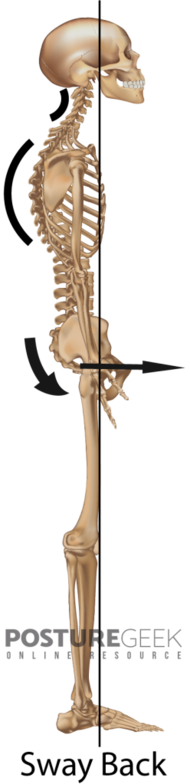
This is sometimes described as a sway-back posture. If you also have back or neck discomfort, it's tempting to connect the two immediately.
But does this posture automatically cause pain?
No. Posture is worth observing, but it doesn't tell the entire story.
What does sway-back posture mean?
The term describes a standing pattern in which the pelvis sits relatively forward in relation to the ankles, while the trunk and spinal curves take on a characteristic alignment. The exact appearance varies from person to person.
A clinician may use the term to describe what they observe, but it shouldn't be treated as a diagnosis of tissue damage or proof that a person's alignment is harmful.
People stand differently. Some have a similar posture without symptoms, while others experience discomfort in certain positions or activities.
Why might posture still matter?
Posture can provide useful information when considered alongside movement and function.
For example, if you stand in one position for a long time and your back becomes uncomfortable, it may be helpful to examine how long you remain there, whether changing position helps and how much standing your body currently tolerates.
A particular posture might also be relevant if it consistently reproduces symptoms or makes a task more difficult.
But these findings need to be tested rather than assumed from appearance.
Is there one correct way to stand?
Most people don't need to hold one rigid position throughout the day.
Your body is designed to move. Standing, sitting, leaning, walking and shifting your weight all change the demands on your muscles and joints.
A position that feels comfortable for a few minutes may become uncomfortable after an hour. That doesn't necessarily mean the position is damaging. It may mean that duration, fatigue or lack of movement is part of the picture.
Instead of trying to maintain perfect alignment, consider whether you can vary your positions and tolerate the demands of your day.
What should a clinician assess?
If you have pain, a useful assessment goes beyond a posture label. It may include your symptom history, spinal and hip movement, strength, endurance, balance and the activities that bring on discomfort.
For someone who struggles with prolonged standing, we may examine standing tolerance and how symptoms change with movement. For someone who hurts during lifting, the assessment may focus more on load management and lifting function.
The plan should reflect the actual limitation.
Should you try to correct sway-back posture?
The answer depends on why you're considering it.
If a movement or position is limiting your function, changing how you move may be useful. Strength, endurance, mobility or movement practice may help address relevant findings.
But changing your appearance is not automatically the same as improving your health. The objective is not to force your body into a single ideal shape.
Let symptoms and function guide the plan
If you've been told your posture is the cause of your pain, it is reasonable to ask how that conclusion was reached.
At Optimal Health, we consider posture as one part of a broader assessment. We want to understand how you move, what you tolerate and what you need to do in daily life. If back or neck discomfort is limiting you, an evaluation can help identify the findings that matter instead of giving you another posture rule to follow all day.