Have you ever been told that one muscle is tight, another is weak, and that this imbalance is the reason your neck or back hurts?
That explanation sounds simple. Sometimes, though, the body is more complicated than that.
Muscle imbalance is a broad term used to describe differences in muscle strength, flexibility, activation, endurance or coordination. These differences may affect how you perform a movement, but they don't automatically mean something is wrong.
What does a muscle imbalance look like?
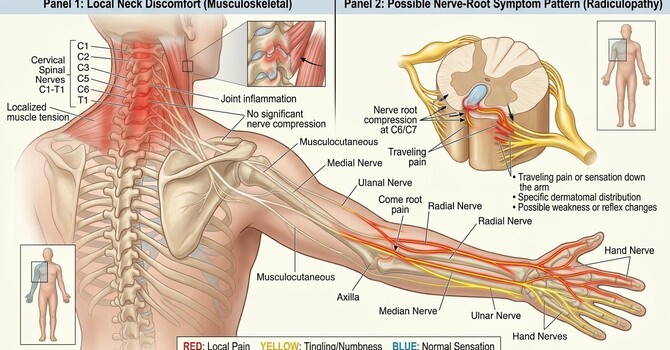
Imagine someone who spends much of the day working at a computer. They have difficulty turning their head comfortably and feel tension around their shoulders by late afternoon.
An assessment might reveal limited movement in the upper back, reduced endurance in certain neck muscles, or difficulty coordinating the shoulder blades during arm movement.
Those findings could help guide care. But they don't prove that sitting caused a particular muscle to become tight or that one weak muscle explains all the symptoms.
The same principle applies to people who lift weights, play golf, run or perform physical work. Their activities place different demands on the body, and their movement patterns reflect more than muscle strength alone.
What did Vladimir Janda contribute?
Czech physician Vladimir Janda helped popularize a clinical approach that considers how muscles work together during posture and movement.
His work includes the concepts of upper crossed syndrome and lower crossed syndrome. These describe recurring patterns of muscle function and posture that clinicians may look for during an assessment.
The value of this framework is that it encourages us to look at relationships between muscles and body regions rather than examining one muscle in isolation.
Its limitations matter, too. A pattern is not a diagnosis of the cause of someone's pain, and not every person fits a textbook description.
Tight doesn't always mean short, and weak doesn't always mean inactive
A muscle may feel tight without having a meaningful loss of flexibility. A muscle may test weaker because of pain, fatigue, reduced practice or difficulty coordinating the movement.
Likewise, a person can have a visible postural difference without pain or functional limitation.
That's why an assessment should examine what a muscle can do, how it performs during relevant tasks and whether the finding actually relates to the person's complaint.
What do we do with the information?
If you have neck discomfort while working, we may look at neck movement, shoulder function, upper-back mobility, strength, endurance and how long you can comfortably maintain your work routine.
If lifting is the problem, we may examine how you manage load and coordinate your hips, trunk and shoulders during the lift.
Treatment should follow the findings. Depending on your needs, that could include strength training, mobility work, movement retraining, activity changes or hands-on care as part of a broader plan.
The aim isn't to make every muscle perfectly balanced. It's to improve the movements and activities that matter to you.
A more useful way to think about muscle imbalance
Your body doesn't need to look like a textbook illustration to function well.
If pain or restricted movement is interfering with your work, exercise or daily life, an evaluation at Optimal Health can help identify which findings are relevant and what may help you move more comfortably. We look at the person and their goals, not just a list of muscles labeled tight or weak.