If your knee hurts, you may wonder what will happen during an evaluation. Will someone check the joint? Ask you to squat? Test your strength? Look at your ankle or hip?
The answer depends on your symptoms and history. A useful evaluation isn't simply a checklist of tests. Each part should help answer a question about your condition, your safety, or your ability to perform the activities that matter to you.
First, understand your symptoms
The evaluation usually begins with a conversation about when the pain started, where you feel it, and what makes it better or worse.
A clinician may ask about recent changes in activity, previous injuries, swelling, stiffness, and whether your knee catches, locks, or gives way. Your health history and goals also matter.
These details help determine which possibilities deserve attention and whether additional medical evaluation is needed before proceeding with exercise or hands-on care.
Next, examine the knee
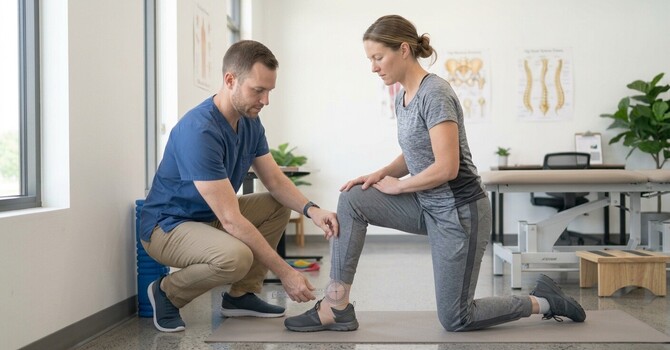
Depending on the presentation, the clinician may assess range of motion, strength, swelling, tenderness, and your ability to bear weight. Specific tests may be appropriate when the history suggests a particular injury or condition.
No single test can answer every question. Results need to be interpreted alongside your history and the overall pattern of symptoms.
The examination may also help identify signs that require referral rather than routine conservative treatment.
Then look at function
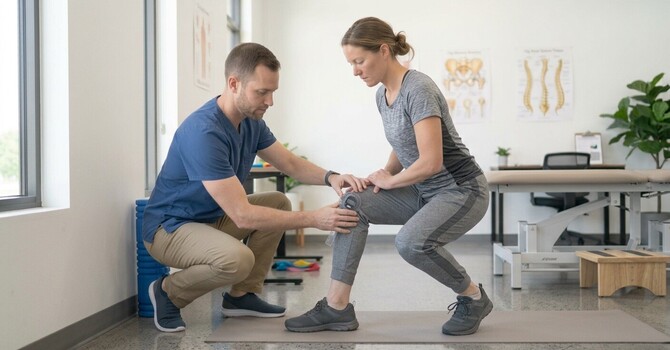
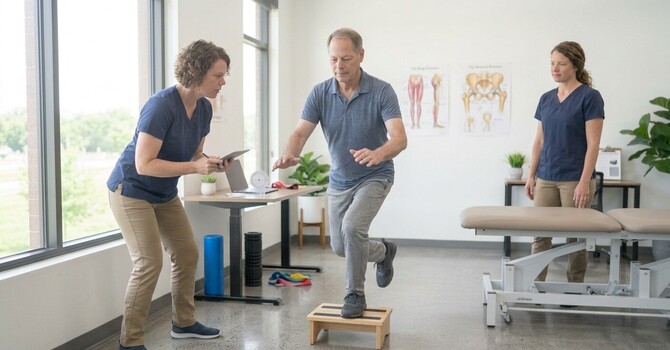
If your knee hurts during stairs, a clinician may assess a step-up or step-down. If squatting is difficult, a squat or sit-to-stand movement may help reproduce the problem. Walking, balance, and other activities may be useful depending on your goals.
These tasks provide information about symptoms, strength, coordination, and how much demand you can currently tolerate. The clinician may also assess hip strength or ankle mobility if those findings could be relevant.
The purpose isn't to grade your movement or find a flaw. It's to understand what happens during a task that matters to you and determine whether a specific limitation is relevant to your symptoms.
Turn the findings into a plan
Once the findings are considered together, the next step is to explain what they suggest, what remains uncertain, and what options make sense.
Depending on the situation, care may involve modifying aggravating activities, building strength, improving a relevant mobility limitation, practicing functional movements, or progressing toward sport or exercise. Some conditions require medical assessment or other care instead.
There is no single exercise or treatment that is appropriate for every knee problem. The plan should reflect the findings, your preferences, your current tolerance, and your goals.
Reassessment is important, too. If symptoms improve and function increases, exercises and activity demands can progress. If the knee isn't responding as expected, the clinician may need to reconsider the working explanation or next steps.
Measure progress by what matters to you
A lower pain rating can be encouraging, but progress should also relate to daily life. Can you climb stairs more comfortably? Walk farther? Return to training? Get through work without constantly thinking about your knee?
Those are practical measures of whether care is helping you move toward your goals.
At Optimal Health, the purpose of an evaluation is to connect your symptoms with your movement and functional needs, then use the findings to guide an individualized plan. You don't need to arrive knowing which structure is responsible. That's part of what the assessment is intended to help clarify.
CTA: If knee pain is affecting your daily routine or keeping you from an activity you value, schedule an evaluation to discuss what you're experiencing and what a reasonable next step might look like.