You look at a photo of yourself at your desk and notice that your head sits forward and your shoulders round toward the screen.
Maybe your neck feels tight, too.
A familiar explanation is upper crossed syndrome, a movement-pattern concept associated with Vladimir Janda. But what does that label actually tell you?
What is upper crossed syndrome?
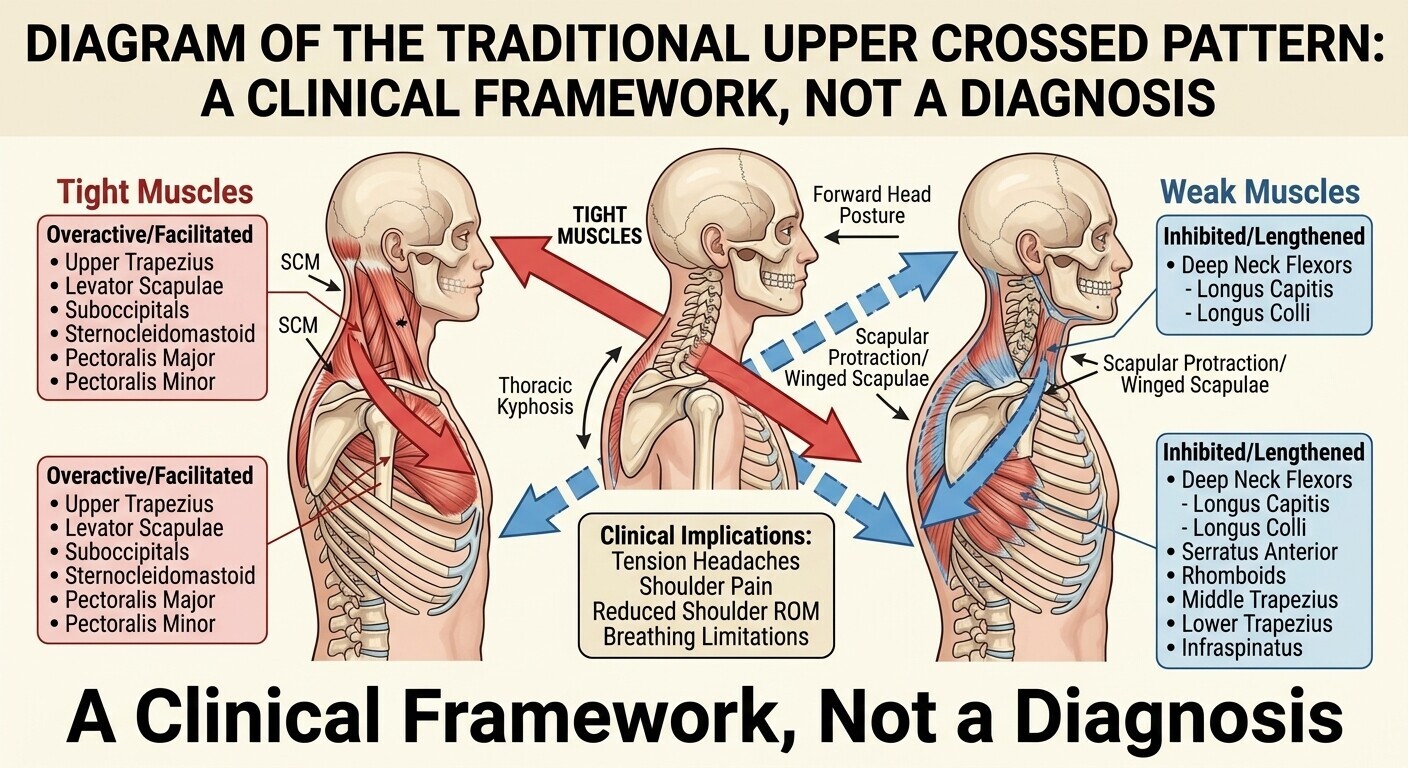
Janda described a recurring pattern involving muscles around the neck, shoulders and upper back. In the traditional model, some muscles are considered more prone to increased tension or activity, while others may demonstrate reduced activation or performance.
The pattern is commonly illustrated with a forward head position, rounded shoulders and changes in the upper-back curve.
It can be a useful way to organize observations during a clinical assessment. It is not, by itself, proof of a specific injury or the cause of neck pain.
Does this posture automatically cause pain?
No single posture explains everyone's symptoms.
Some people with a forward head position or rounded shoulders experience neck discomfort. Others have similar postures and feel fine.
Symptoms can be influenced by many factors, including how long you've been working, your activity demands, sleep, stress, physical capacity and the way your neck and shoulders respond to movement.
Posture is one piece of the picture, not a verdict.
What should an assessment look at?
Instead of simply measuring how far forward your head sits, a clinician may ask:
-
Does turning or tilting your neck reproduce your symptoms?
-
How does your upper back move?
-
Can you raise your arms comfortably?
-
How do your shoulder blades move during reaching?
-
How does your neck respond over a long workday?
-
Are strength, endurance or movement control limiting a specific activity?
These questions connect the examination to your actual problem. Someone who struggles to check their blind spot while driving may need a different plan from someone whose neck aches after hours of computer work.
What about corrective exercises?
Exercises may be useful when they address a relevant limitation. Depending on the findings, a program could include neck strengthening, shoulder-blade exercises, upper-back mobility work, endurance training or changes to the way you organize your workday.
The evidence needs careful interpretation. A 2026 systematic review and meta-analysis found that corrective exercise programs improved measured postural alignment in people classified as having upper crossed syndrome, but results for pain, function and muscle activation were less consistent. Improving a posture measurement does not guarantee that pain or daily function will improve.
That is one reason we shouldn't prescribe the same “posture correction” routine to everyone.
You don't need to hold perfect posture all day
Your body is designed to move between positions. Trying to hold your shoulders back and your chin tucked from morning to evening can become uncomfortable in its own right.
Changing positions, taking movement breaks and building tolerance for your daily activities may be more practical than chasing one ideal alignment.
If you have neck or shoulder symptoms, the goal is to find out what affects them and what helps you function better.
Look at the pattern, then look at the person
Upper crossed syndrome can offer a starting framework, but it shouldn't end the assessment. At Optimal Health, we consider posture alongside movement, strength, symptom behavior and your goals. If neck tension is interfering with work, driving or exercise, an evaluation can help determine whether the pattern is relevant and what steps make sense for you.