“Sciatica” is one of those words people often use to describe almost any back pain that travels into the buttock or leg.
But sciatica and ordinary low back pain aren't interchangeable terms.
Understanding the difference can help you make sense of what you're feeling and why an evaluation may look at more than just your lower back.
Low back pain can stay local
Many episodes of low back pain are felt primarily around the lumbar region.
You may notice aching, stiffness or soreness around your lower back. Certain activities or positions may aggravate it, while others may feel better.
The symptoms can be uncomfortable without traveling down the leg.
That is different from a pattern involving nerve-related symptoms.
What makes sciatica different?
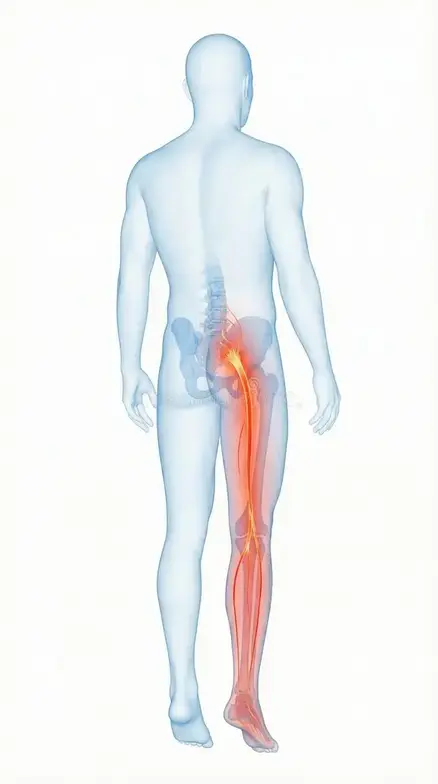
Sciatica generally refers to symptoms that follow the distribution of the sciatic nerve and its associated nerve roots.
Instead of staying in the low back, symptoms may travel through the buttock and into the leg.
People may describe these symptoms as pain, burning, tingling, numbness or, in some cases, weakness.
The exact pattern matters.
Pain traveling into the leg doesn't automatically mean you have sciatica, and not every person with back pain needs to be labeled with a nerve diagnosis. Several conditions can produce overlapping symptoms.
That's why the history and physical examination matter.
Why does a problem in your back affect your leg?
The nerves that supply the lower extremity originate from the lower spine.
When nerve tissue or a nerve root becomes irritated or compressed, symptoms can be felt farther away from the original source.
This is one reason the location of the symptom isn't always the location of the problem.
Think about it like this: if an electrical cable is irritated closer to its source, you wouldn't necessarily feel the problem only at the point where the cable enters the wall. The symptoms could be experienced farther along its path.
The human nervous system is obviously more complicated than an electrical cable, but the analogy helps explain why leg symptoms can be relevant when evaluating the low back.
What will a clinician look for?
A good evaluation doesn't stop at asking whether your leg hurts.
It may include checking strength, sensation, reflexes, movement, walking mechanics and how certain movements affect your symptoms.
The clinician will also want to know whether symptoms are changing over time.
Are they becoming more intense?
Are they traveling farther down the leg?
Are you developing numbness or weakness?
Are certain movements consistently changing the symptoms?
Those details can help determine whether your presentation is more consistent with localized low back pain, nerve-related symptoms or another condition.
Don't assume every leg symptom means the same thing
Pain down the leg has several possible causes.
That's why “I have pain in my leg” isn't enough information to determine what is happening.
A thorough evaluation considers the lumbar spine, pelvis, hip, neurological system and the person's overall presentation rather than jumping to a conclusion from one symptom.
When should you seek medical attention?
New or progressive weakness, significant numbness, new bowel or bladder problems, saddle-area numbness, major trauma, fever or other concerning systemic symptoms warrant medical evaluation.
If symptoms are rapidly changing or you are unsure whether they require urgent attention, it's better to be evaluated than to guess.
The goal isn't just to name the problem
A diagnosis can be useful, but the bigger goal is understanding what you can do next.
If you're having back pain with or without leg symptoms, the right plan should account for your symptoms, movement, strength, activity demands and goals.
Whether your goal is walking comfortably, getting through a workday, returning to the gym or getting back on the golf course, the evaluation should eventually connect back to that goal.