“I think I pinched a nerve.”
“I have sciatica.”
Patients often use these phrases to describe similar symptoms, especially when pain travels from the back or buttock into the leg.
But they aren't quite the same thing.
Understanding the difference can make it easier to understand what a clinician is actually looking for during an evaluation.
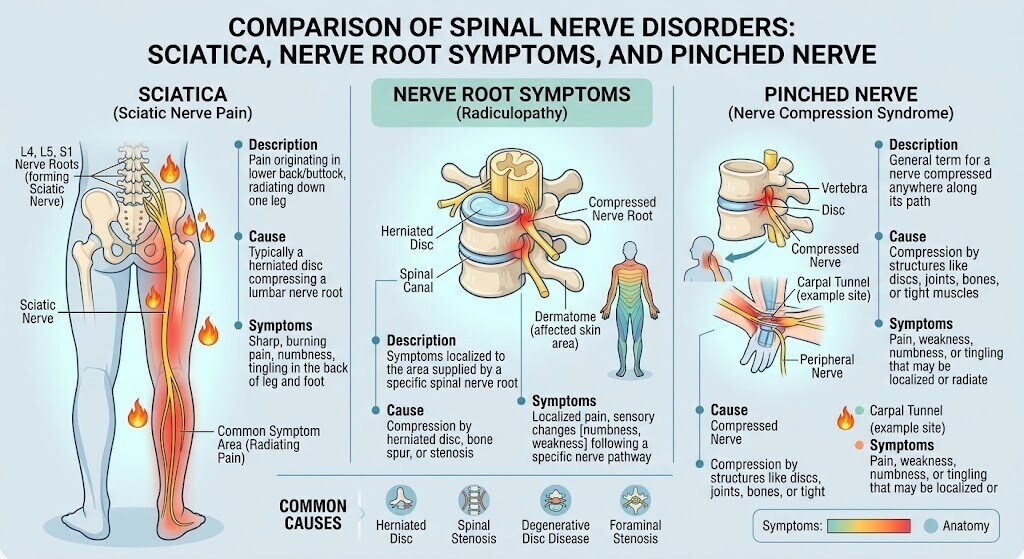
“Pinched nerve” is a general phrase
“Pinched nerve” is a common way of describing a nerve that seems irritated or compressed.
It's easy to understand, but it isn't a very precise diagnosis.
A nerve can become irritated for different reasons, and symptoms don't always mean that the nerve is literally being squeezed like a hose.
That's why clinicians may use more specific terms such as nerve root involvement, radicular pain or radiculopathy depending on the findings.
So what does “sciatica” mean?
Sciatica is generally used to describe symptoms involving the sciatic nerve distribution, often related to the lower spinal nerve roots. NICE specifically uses “sciatica” to describe leg pain secondary to lumbosacral nerve root pathology.
In everyday conversation, however, the word gets used much more broadly.
Someone might call any pain traveling into the leg “sciatica.”
That's where things can get confusing.
Not every case of leg pain is sciatica, and not every case of sciatica means the same thing is happening.
What does nerve-related pain feel like?
Nerve-related symptoms can include:
- Burning
- Tingling
- Electric or shooting pain
- Numbness
- Changes in sensation
- Weakness
But symptoms alone aren't enough to make a diagnosis.
A burning sensation doesn't automatically mean a nerve is involved.
Likewise, an ache doesn't automatically mean a muscle is responsible.
The pattern matters.
Why does the examination matter?
A clinician may assess your muscle strength, sensation, reflexes and movement.
They may also look at how your symptoms change with different positions or repeated movements.
For example, does sitting change your leg pain?
Does walking change it?
Does bending forward change the symptoms?
Does the pain move closer to your back or farther down your leg?
These details can help distinguish different presentations.
You don't want to chase the label
It can be tempting to search for the perfect diagnosis online.
But the more useful question is often:
“What is happening with my symptoms, and what can we do about it?”
A good clinical evaluation should help answer that question.
For some people, an active rehabilitation plan may be appropriate.
For others, symptom management and education may be the first step.
Manual treatment may be useful for some patients as part of a broader plan, while exercise and progressive activity may become more important as symptoms improve.
NICE recommends exercise and continued activity as part of the management of low back pain with or without sciatica, with treatment tailored to the individual's needs and capabilities.
When should you take leg symptoms seriously?
New or progressive weakness, significant numbness, new bowel or bladder changes, saddle-area numbness, major trauma, fever or other concerning symptoms warrant appropriate medical evaluation.
Don't try to diagnose those symptoms from a blog post.
The bottom line
Sciatica and “pinched nerve” aren't perfect synonyms.
“Pinched nerve” is a general phrase. Sciatica describes a particular pattern of leg symptoms associated with lumbosacral nerve-root involvement.
The important part isn't memorizing the terminology.
It's understanding your individual symptoms and determining what your body needs to return to normal activity.