Why Does My Knee Hurt When I Run? Common Causes of Running Knee Pain
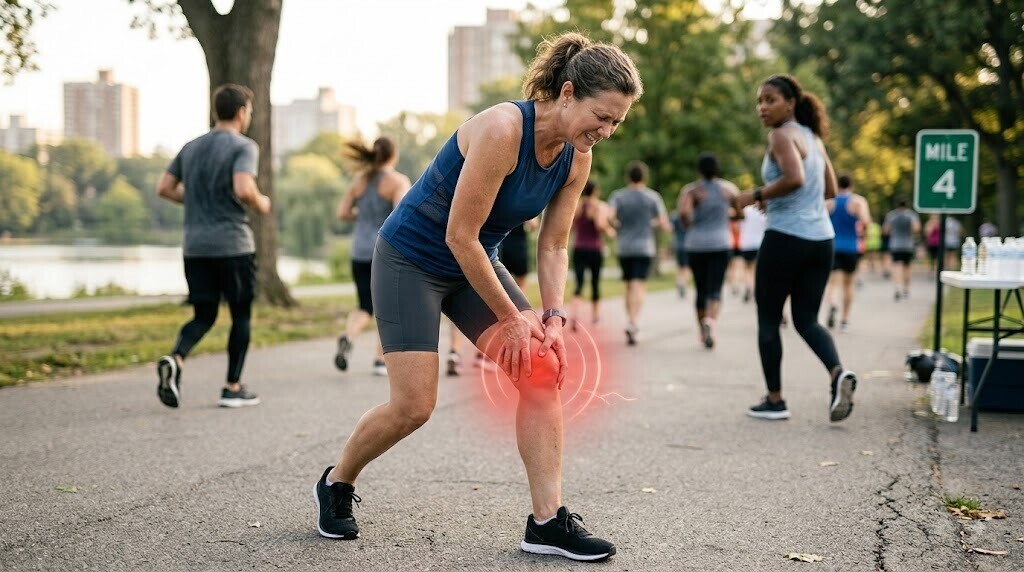
You lace up your shoes, head out for a run, and everything feels good.
Then a mile or two in, your knee starts to ache.
Maybe it's underneath your kneecap. Maybe it's along the outside of your knee. Maybe you notice it going downhill, climbing stairs, or sitting down after your run.
So you do what most runners do: you try to run through it.
Sometimes that works for a while.
Then the pain comes back.
Knee pain is one of the most common problems affecting runners. A 2026 systematic review identified knee injuries as a substantial portion of running-related injuries and found that previous injury and training load were among the most consistently reported risk factors.
But there isn't one universal reason a runner's knee hurts.
Your training, previous injuries, strength, movement, recovery, and the demands you're placing on your body can all be part of the picture.
Where does running knee pain usually come from?
“Runner's knee” isn't one specific diagnosis.
Knee pain while running can come from several different conditions, and the location and behavior of the pain can provide useful clues.
Pain around or behind the kneecap
Pain around the front of the knee is commonly associated with patellofemoral pain.
You may notice it while running, squatting, climbing or descending stairs, or sitting for a long time with your knee bent.
Patellofemoral pain is common in active people, but it doesn't necessarily mean something is wrong with the cartilage underneath your kneecap or that your knee is being “worn out.”
The problem is often more complicated than that.
Treatment typically focuses on improving the knee's ability to tolerate load and addressing relevant strength and movement factors. Clinical practice guidelines emphasize individualized management rather than assuming that every person with kneecap pain needs the same treatment.
Pain along the outside of the knee
Pain on the outside of the knee can occur with iliotibial band-related pain, particularly in runners.
It may appear after a certain amount of running and become more noticeable as the run continues.
Your hip and pelvis, training volume, running mechanics, and other factors may be relevant, but it's important not to assume that one “tight muscle” is automatically responsible.
Pain at or below the kneecap
Pain associated with the patellar tendon can be more noticeable with jumping, running, stairs, or other activities that repeatedly load the knee extensor system.
Again, the important question is not simply where the pain is.
It's how your knee is responding to the amount and type of load you're asking it to handle.
Did you increase your running recently?
This is one of the first questions worth asking.
Maybe you started training for a race.
Maybe you added another running day.
Maybe you increased your mileage because your last few runs felt easy.
Or perhaps you returned to running after several months away and picked up where you left off.
Changes in running volume, frequency, intensity, or duration can matter.
A 2026 systematic review of knee injuries in endurance runners found that increased training load or volume was among the most recurrent risk factors for several common knee conditions.
At the same time, the research isn't strong enough to say that every runner who increases mileage will get hurt.
A previous systematic review found the evidence linking specific changes in training load to running injuries was limited and conflicting.
That's why a rigid rule such as “never increase mileage by more than exactly 10%” isn't a substitute for paying attention to your individual response.
Your knee is giving you information.
Listen to it.
What about your hips and glutes?
You've probably heard that knee pain is caused by “weak glutes” or “tight hips.”
There may be something useful behind that idea, but the explanation is often oversimplified.
Your hip, pelvis, knee, ankle, and foot all contribute to how your body handles running.
If strength, mobility, coordination, or control are limited somewhere along that chain, it may influence how you move.
But that doesn't mean a weak glute automatically causes knee pain.
Current research suggests running injuries are multifactorial, with training characteristics, previous injury, health and lifestyle factors, and biomechanical factors all potentially contributing.
That's why a good assessment doesn't stop at the painful knee.
It looks at the runner.
Your knee may not be the only thing worth examining
Imagine two runners with identical knee pain.
One recently doubled their weekly mileage.
The other has been running the same mileage for six months but has gradually developed pain when going downhill.
They may have the same general complaint, but they don't necessarily have the same problem.
A movement-based assessment can consider things such as:
-
Hip strength and control
-
Ankle mobility
-
Lower-extremity strength
-
Knee movement
-
Running mechanics
-
Training volume and intensity
-
Recovery between runs
-
Previous injuries
-
Symptoms during and after running
This is consistent with Optimal Health's movement-focused approach, which emphasizes assessing the full movement pattern rather than focusing only on where the patient feels pain.
The goal isn't to find one “bad” body part.
It's to understand the whole system.
Does running itself damage your knees?
This is an important misconception to clear up.
Running isn't automatically bad for your knees.
In fact, the relationship between running and injury is much more complicated than “running wears out your joints.”
The bigger issue for an individual runner is whether the current training demands are appropriate for their current capacity.
That can change over time.
A runner who comfortably handles 20 miles per week may struggle if they suddenly start doing 35.
A runner returning from an injury may need a slower progression than someone who has maintained consistent training.
A runner who has recently changed their schedule, terrain, speed work, or race preparation may need to adjust their overall workload.
The question isn't simply:
“Is running bad for my knee?”
It's:
“Is my knee currently prepared for the running I'm asking it to do?”
Should you stop running if your knee hurts?
Not always.
Whether you should continue running depends on the severity and behavior of your symptoms.
If your pain is mild and predictable, doesn't progressively worsen during the run, and settles appropriately afterward, modifying your training may be reasonable.
That might mean temporarily reducing distance, slowing the pace, taking additional recovery days, or replacing some runs with another form of exercise while you build capacity.
If pain is increasing, changing your running mechanics, causing significant swelling, or continuing to worsen after activity, continuing to push through it isn't a good strategy.
An evaluation can help determine what level of activity makes sense.
The goal isn't always complete rest.
It's finding an appropriate level of load and progressing from there.
What exercises help running knee pain?
There isn't one exercise that fixes every runner's knee.
That may be disappointing if you're searching for “the best exercise for runner's knee,” but it's actually good news.
It means your rehabilitation can be built around your specific needs.
Depending on the presentation, a program may include strengthening for the:
-
Quadriceps
-
Glutes and hip muscles
-
Calf muscles
-
Hamstrings
-
Trunk
-
Other muscles involved in controlling the lower extremity
Exercise-based treatment has evidence for managing patellofemoral pain, and current clinical guidance supports tailoring rehabilitation to the individual's presentation.
The key is progression.
If you become stronger but immediately return to the same running volume that irritated your knee, you haven't necessarily solved the problem.
Your strength and your running capacity need to catch up with each other.
What about changing your running form?
Running technique can be relevant for some runners, but this is another area where internet advice can get overly confident.
You may hear that everyone should change their foot strike, increase cadence, shorten their stride, or run a certain way.
There isn't enough evidence to say that one running style is best for everyone.
A systematic review of interventions for running-related knee injuries found low-certainty evidence that certain technique-retraining strategies may help in specific circumstances, while evidence for many other prevention strategies was limited or inconsistent.
So rather than automatically changing your running form, a clinician may first determine whether your mechanics are actually relevant to your symptoms.
If they are, a gradual technique change may become part of the plan.
What should you do if your knee pain keeps coming back?
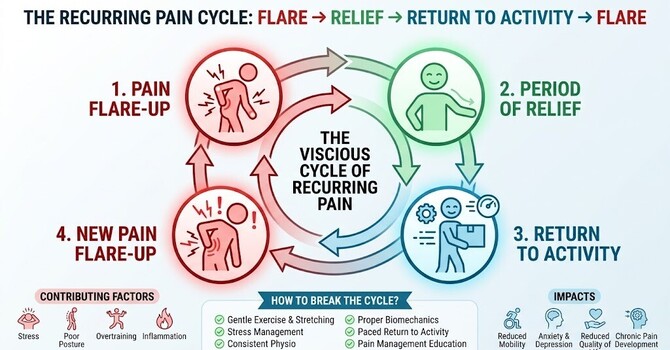
This is where recurring knee pain deserves a closer look.
If your knee feels better whenever you stop running but hurts again every time you return, simply repeating the same cycle of rest and return may not be enough.
You may need to address the gap between your current capacity and your running demands.
That can involve gradually rebuilding strength, improving relevant mobility, modifying training volume, working on running tolerance, and addressing factors that may have contributed to the original problem.
At Optimal Health, the clinical philosophy combines movement assessment, hands-on care when appropriate, rehabilitation, and progression toward the activities that matter to the patient. The practice specifically identifies running pain as an area where looking beyond the painful location is part of its approach.
For a runner, the endpoint isn't simply:
“Your knee doesn't hurt today.”
It's being able to run, recover, train, and gradually increase your workload without constantly starting over.
When should you get running knee pain evaluated?
Some soreness after a new or unusually demanding workout isn't necessarily a reason for alarm.
But consider an evaluation if:
-
Knee pain keeps returning every time you run
-
Your pain is getting progressively worse
-
You develop significant swelling
-
Your knee locks or repeatedly gives way
-
You can't fully bend or straighten the knee
-
Pain is changing how you run
-
You can't return to your normal activity without symptoms
-
You have significant pain following a traumatic injury
Persistent knee pain also deserves attention if you're repeatedly modifying your life around it.
You shouldn't have to give up running simply because every attempt to return ends with the same pain.
A better way to think about running knee pain
Your knee isn't necessarily failing.
It may be telling you that something about the current demand isn't matching your current capacity.
That doesn't mean there is one muscle to blame.
It doesn't mean your running form is broken.
And it doesn't mean you need to stop running forever.
It means there's an opportunity to figure out what is contributing to the problem.
At Optimal Health Chiropractic & Physical Therapy, that starts with looking at the runner as a whole rather than treating the knee in isolation.
The assessment may consider movement, strength, mobility, training demands, previous injury, and how your symptoms respond to different activities. From there, conservative treatment and rehabilitation can be progressed toward your actual goal.
Because if you run, your goal probably isn't simply to have a pain-free knee sitting on the couch.
You want to run.
And the right plan should help you work toward that.