.jpg)
If you often find yourself reaching back to rub a stubborn, aching spot in your upper back, you’re not alone. Pain between the shoulder blades is one of the most common complaints we see at Optimal Health.
When this area starts to hurt, it’s easy to assume something serious is going on. But in many cases, the cause is much more straightforward — everyday posture, muscle tension, joint stiffness, or stress.
Our team at Optimal Health, serving South Jersey, wants you to understand why this area is so prone to irritation. Once you know what’s driving the pain, it becomes much easier to find lasting relief.
Here’s a closer look at what usually causes pain between the shoulder blades — and what you can do about it.
How the Pain Actually Feels
Upper back pain doesn’t feel the same for everyone. Depending on the muscles, joints, or nerves involved, your symptoms can shift throughout the day.
For many people, it shows up as a deep, dull ache right between the shoulder blades. You might feel a burning sensation that creeps up toward your neck after sitting at a desk or computer for too long. Others describe it as tightness — almost like a knot that never fully releases.
You may also notice that your symptoms change depending on your position. The discomfort often worsens after long periods of sitting, especially in a car or at a desk. You may feel some relief when lying down, stretching, or applying heat.
These patterns usually point to a mechanical issue rather than something more serious.
Common Causes of Upper Back Pain
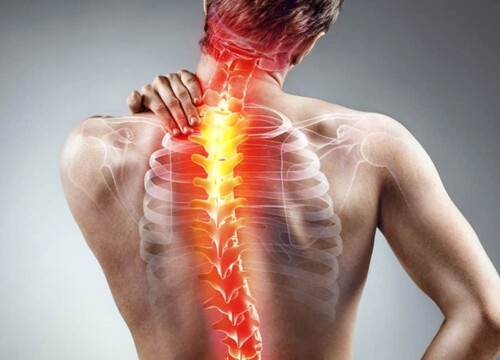
The area between your shoulder blades includes the thoracic spine, ribs, muscles, and connective tissues that work together to support your posture and upper body movement. Muscles like the rhomboids, trapezius, and erector spinae help stabilize your shoulders, support your neck, and keep you upright throughout the day.

When these structures are overloaded or not moving well, pain and tightness can build up.
Here are some of the most common contributors:
Poor Posture and Desk Slouching
Your head weighs roughly 10 to 12 pounds. When you sit with proper alignment, your spine easily supports this weight. However, when you slump forward at your desk, that weight shifts.
As your head moves forward, the muscles between your shoulder blades have to work overtime to keep your head from dropping into your lap. Over weeks and months of slouching, these muscles become exhausted, overstretched, and sore. This constant strain is a leading driver of that dull, nagging ache in your upper back.

Long Hours of Screen Time
Whether you are scrolling on your phone, reading a tablet, or staring at a dual-monitor setup, screen time changes your body mechanics. We tend to round our shoulders forward when we engage with screens.
This rounded posture limits blood flow to the muscles in the upper back. The lack of movement causes the tissues to become stiff and irritated. Limiting your screen time is difficult, but understanding its physical impact is the first step toward correcting the problem.

Muscle Tension in the Upper Back, Neck, and Shoulders
Your neck, shoulders, and upper back operate as a closely connected system. When a muscle in one area tightens up, the surrounding muscles try to compensate.
For example, if your shoulder muscles are tight from lifting heavy boxes, your upper back muscles might tense up to stabilize your spine. This chain reaction creates broad areas of tension. Eventually, that tension concentrates right between your shoulder blades, creating a stubborn knot that refuses to release.

Thoracic Spine Stiffness
Your thoracic spine is designed to twist, bend, and extend. Unfortunately, modern life requires very little of this natural movement. We sit in chairs, face forward, and rarely reach behind us or twist our torsos.
When you do not move your thoracic spine through its full range of motion, the joints become stiff. Stiff joints force the surrounding muscles to work much harder to create basic movements. This joint stiffness frequently triggers sharp or aching pain between the shoulder blades when you finally try to stretch or rotate.
Stress-Related Muscle Tightness
Mental and emotional stress take a very real physical toll on your body. When you feel overwhelmed or anxious, your nervous system kicks into a protective mode.
This biological response instinctively causes you to hike your shoulders up toward your ears and tighten your chest. You might not even realize you are holding this tension until the end of the day. This sustained contraction exhausts the muscles in your upper back, leading to a deep, burning soreness.

Referred Pain from the Neck or Shoulders
Sometimes, the pain between your shoulder blades does not actually originate there. Issues in your neck or shoulder joints can send pain signals down into your upper back. This phenomenon is known as referred pain.
For instance, a stiff joint in your lower neck might irritate a nerve path that travels down to your shoulder blade. Movement issues in the shoulder joint itself can also pull on the muscles that attach to your mid-back. Treating the upper back alone won't solve this specific issue; you have to address the neck or shoulder to find relief.

Practical, Non-Surgical Treatment Approaches
You do not have to just live with a nagging ache in your upper back. Because this pain usually stems from mechanical issues, it responds incredibly well to conservative, non-invasive treatments.
At Optimal Health, we use a comprehensive approach to help you overcome upper back pain. Our clinics in Egg Harbor Township and Turnersville offer several proven therapies to get you moving comfortably again.
Chiropractic Care
Chiropractic adjustments focus on restoring proper motion to your joints. If you have severe thoracic spine stiffness, your joints are likely not gliding as they should.
Our chiropractors gently adjust the spine and ribs to improve mobility. By restoring natural joint mechanics, we remove the excessive strain on your upper back muscles. This frequently provides immediate relief from tightness and sharp pains.
Physical Therapy
Strong, flexible muscles are your best defense against recurring upper back pain. Physical therapy helps you rebuild the endurance your body needs to handle daily tasks.
Our physical therapists work with you to improve your resting posture, increase your thoracic mobility, and strengthen your upper back and core. We design custom programs that directly target the weak areas contributing to your slouching or muscle fatigue.
Manual Therapy
When your muscles are locked in a state of chronic tension, they need hands-on help to release. Manual therapy targets the soft tissues holding onto stress and strain.
We use specific hands-on techniques to reduce muscle tension, break up painful trigger points, and improve local blood flow. This direct tissue work softens the "knots" between your shoulder blades and prepares your body for corrective exercises.
Movement Assessments
To truly eliminate upper back pain, we have to figure out exactly why it started in the first place. This requires a detailed look at how you move.
We perform comprehensive movement assessments to identify the specific habits, weaknesses, or joint limitations contributing to your discomfort. Whether it is a stiff neck joint referring pain downward or a dysfunctional shoulder pattern, we find the root cause so we can treat it effectively.
Corrective Exercises and Mobility Work
Healing does not stop when you walk out of our clinic doors. We believe in giving you the tools you need to maintain your progress at home or at work.
We will teach you simple, highly effective corrective exercises to keep your thoracic spine mobile. You will learn specific stretches to counteract hours of sitting and targeted movements to keep your shoulders healthy.
Find Relief at Optimal Health
Pain between the shoulder blades can be frustrating, but it’s highly treatable. When you address the root cause — whether it’s posture, joint stiffness, or muscle imbalance — you can move more comfortably and consistently.
At Optimal Health, we help patients across South Jersey understand what’s causing their pain and build a plan for long-term relief.
If you’re dealing with recurring upper back discomfort, we invite you to schedule an evaluation.
Visit us in Egg Harbor Township or at our Turnersville location (121 Johnson Road, Unit 1, Turnersville, NJ 08012).
To schedule an appointment, call:
Egg Harbor Township: 609-415-2821
Turnersville: 856-295-0366
Let’s help you get back to feeling and moving better.