“It's not really pain. It's more of a burning feeling.”
“My leg keeps going numb.”
“It feels like pins and needles.”
“It's just an ache.”
Those descriptions may sound similar, but they aren't necessarily telling us the same thing.
When you're dealing with back or leg symptoms, how you describe the sensation can provide useful information during an evaluation.
It doesn't give us a diagnosis by itself, but it helps create the bigger picture.
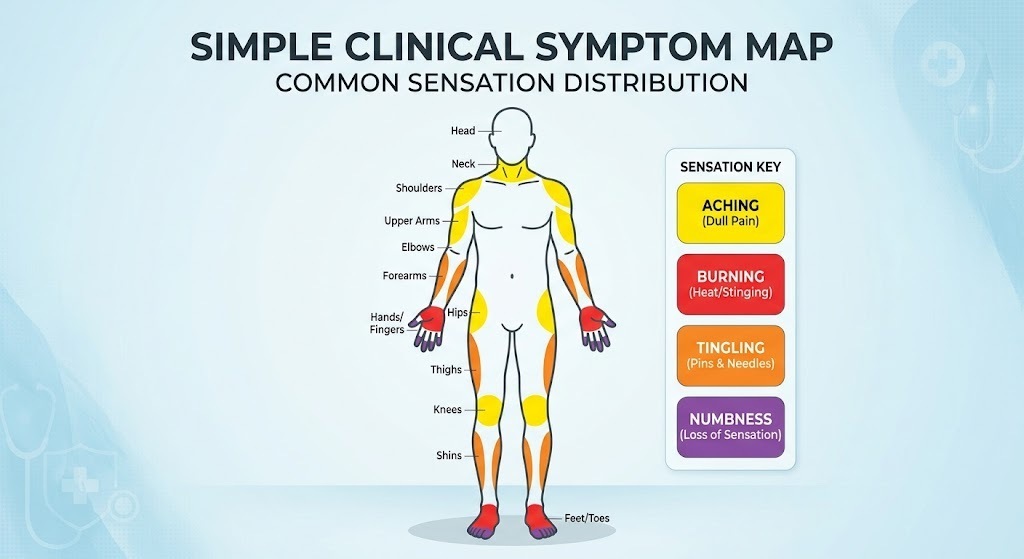
Aching
An ache is one of the most common descriptions of musculoskeletal pain.
It may feel deep, sore or uncomfortable.
An aching sensation can occur with many different conditions, so it isn't specific to one tissue.
That's why “it aches” isn't enough to tell us whether the muscles, joints, nerves or another structure are involved.
Burning
Burning can sometimes be associated with nerve-related symptoms.
But again, the sensation alone doesn't prove that a nerve is involved.
The location, pattern, associated symptoms and examination findings all matter.
Tingling or “pins and needles”
Tingling can be particularly relevant when evaluating the nervous system.
You may notice it in part of your leg or foot, sometimes along with pain or altered sensation.
A clinician may compare sensation between sides and look at strength, reflexes and movement.
Numbness
Numbness means that sensation has changed.
You may feel less sensation in a particular area or describe the skin as feeling “asleep.”
Persistent or progressive numbness deserves attention, especially if it is accompanied by weakness or other neurological changes.
What about sharp or shooting pain?
Sharp, electric or shooting pain can occur with nerve-related symptoms, but it can also occur in other musculoskeletal presentations.
Again, the pattern matters.
Does the pain travel?
Does it follow a particular area?
Does movement change it?
Does it occur with numbness or tingling?
Does it come with weakness?
Those are the kinds of questions that make the description more useful.
Don't try to diagnose yourself from the sensation
This is one of the biggest mistakes people make.
They read that burning equals nerve pain, so they decide they have a pinched nerve.
Or they read that aching equals muscle pain and assume that's the problem.
Human symptoms don't always fit into neat categories.
A clinician uses the symptom description as one piece of information alongside the history and physical examination.
Why strength matters
If you're experiencing leg symptoms, strength testing can be particularly important.
A change in strength can provide different information from pain alone.
That's why an evaluation may include specific muscle testing, reflexes and sensory testing.
Progressive neurological weakness is especially important to have medically evaluated.
What should you do?
Start by paying attention to the pattern.
Write down what you're feeling.
Notice what activities make it better or worse.
Pay attention to whether symptoms are moving, changing or becoming more intense.
And don't ignore significant neurological changes.
At Optimal Health, we want to understand more than just your pain score. We want to understand what you're feeling, how you're moving and what those symptoms are keeping you from doing.
That information helps create a more individualized plan.