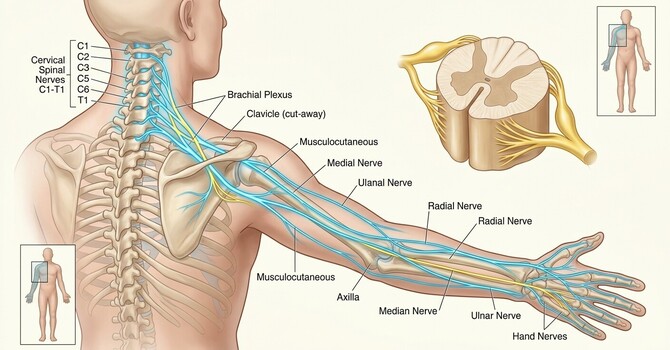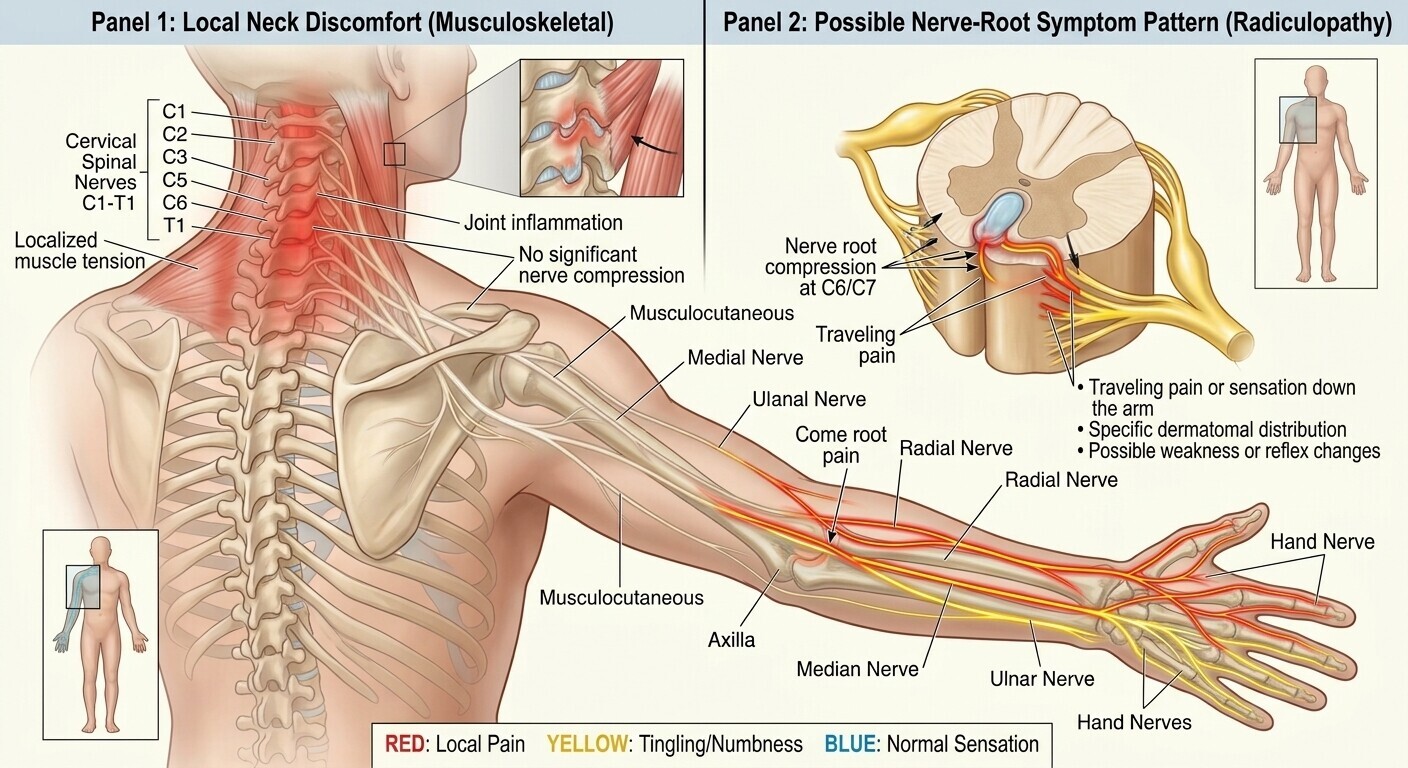
The pain starts in your neck, then travels into your shoulder or arm. Maybe you notice burning, tingling or numbness in your fingers.
Someone tells you that you probably have a pinched nerve.
That may be one possibility, but neck pain alone doesn't prove a nerve is being compressed. Understanding the difference matters because the assessment and next steps may be different.
What do we mean by neck pain?
Neck pain is a symptom, not a single diagnosis. It can be associated with muscles, joints, discs and other structures around the cervical spine.
Some people feel a local ache or stiffness. Others notice discomfort when turning their head, working at a computer or looking over their shoulder.
Neck pain can also be present alongside symptoms in the shoulder, arm or hand. The location and behavior of those symptoms help guide the examination.
What is a pinched nerve?
The phrase pinched nerve is commonly used to describe a nerve that is being compressed or irritated. In the neck, irritation or compression of a nerve root may cause cervical radiculopathy.
Possible symptoms include pain traveling down the arm, tingling, numbness, changes in sensation or weakness in particular muscles.
However, not every person with neck pain radiating into the arm has a confirmed nerve-root problem. Symptoms can overlap with shoulder conditions and peripheral nerve problems, and the term “pinched nerve” is often used before the actual cause has been established.
How can clinicians tell the difference?
The evaluation begins with your history.
Where does the pain travel? Which fingers feel different? Does neck movement change the symptoms? Is there weakness, or is movement limited because it hurts? Did the symptoms begin after an injury or develop gradually?
A physical examination may assess neck and shoulder movement, muscle strength, sensation and reflexes. Specific tests may help determine whether the pattern is consistent with nerve-root involvement or suggests another explanation.
The results must be interpreted together. A single provocative test is not enough to establish the diagnosis.
Does a pinched nerve always need an MRI?
Not necessarily.
Imaging can be valuable when the history and examination suggest that it is needed, but a scan isn't automatically required for every episode of neck pain or arm symptoms.
Imaging findings also need to be interpreted alongside symptoms and clinical findings. A structural change on a scan may not fully explain what you're experiencing.
If there are progressive neurological deficits, significant trauma or concerns about a more serious condition, the threshold for further medical evaluation may be different.
What can treatment involve?
The appropriate plan depends on the findings and how symptoms are changing.
For some people, conservative care may include graded activity, exercises selected for their presentation, movement modifications and symptom monitoring. Other people may need referral for medical assessment or additional testing.
The aim isn't to force the nerve through painful movements or assume that every case needs the same treatment. It's to identify the most likely explanation, monitor neurological function and choose an appropriate next step.
Seek prompt medical evaluation for new or worsening weakness, clumsy hands, difficulty walking, loss of coordination or bowel or bladder changes. Sudden stroke-like symptoms require emergency care.
Get clarity before choosing a treatment
If your neck pain extends into your arm, or you're unsure whether your symptoms suggest nerve involvement, Optimal Health can evaluate your movement, strength and symptom pattern to help determine an appropriate path forward.
You don't have to diagnose a pinched nerve yourself. A careful assessment can help distinguish what may be manageable conservatively from what needs further medical investigation.