If your back feels stiff, you might assume you need to stretch.
If your back feels unstable, you might assume you need to strengthen your core.
But movement problems aren't always that simple.
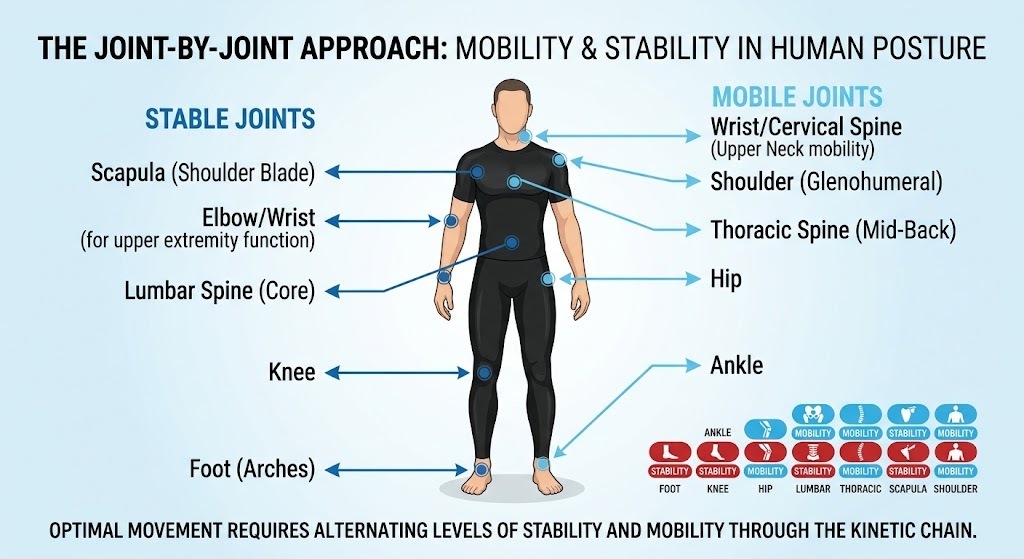
Your low back needs both mobility and stability.
The question is how much of each you need for the activities you're asking your body to perform.
What does mobility mean?
Mobility is the ability to move through an available range of motion.
Your spine, hips and other joints all need enough mobility to perform everyday tasks.
You need to bend.
You need to rotate.
You need to extend.
You need to move from one position to another.
But more isn't automatically better.
A person who already has plenty of motion may not benefit from repeatedly trying to create even more.
What does stability mean?
Stability is often misunderstood as “keeping everything still.”
In movement, stability is better thought of as the ability to control a position or movement while responding to changing demands.
Your trunk needs to control forces while you walk, lift, run and exercise.
That doesn't mean your spine should never move.
It means you need enough control to manage the movement and load involved in the task.
Why does the distinction matter?
Imagine two people with low back pain.
Person A has limited hip mobility and struggles to reach certain positions.
Person B has plenty of motion but has difficulty controlling their trunk during lifting.
Giving both people the exact same stretching routine doesn't make much sense.
Likewise, giving both people the same “core stability” routine may miss what each person actually needs.
The evaluation should help determine which limitation is relevant.
Can you have too much mobility?
Yes, in the sense that additional range isn't automatically beneficial.
Some people naturally have a lot of joint motion.
Others may have difficulty controlling that motion under load.
For those people, repeatedly stretching may not address the actual problem.
The answer may involve strength, endurance, coordination or control.
Can you be strong but lack mobility?
Absolutely.
Strength doesn't automatically create usable range of motion.
If a joint doesn't have enough movement for a particular task, simply making the surrounding muscles stronger may not solve the limitation.
Again, the solution depends on what the individual actually needs.
What does your back need?
That's the question.
Not:
“What's the best back stretch?”
“What's the best core exercise?”
“What's the best mobility drill?”
Instead:
What is limiting this person right now?
A clinician may assess your lumbar and hip mobility, strength, movement control and functional capacity.
Then the plan can be built around the findings.
Mobility and stability work together
This isn't really an either-or decision.
Your body needs movement and control.
You need enough mobility to get into a position and enough strength and coordination to control that position.
That's true whether you're picking up your child, climbing stairs, swinging a golf club or lifting a barbell.
The right balance depends on the person and the task.
The goal isn't perfect movement
There's no prize for having the most mobile hips or the strongest core.
The goal is being able to move confidently and tolerate the demands of your life.
If your back pain is limiting you, an individualized evaluation can help determine whether mobility, stability, strength, endurance or another factor deserves attention.