If your lower back arches noticeably when you stand, you've probably heard a few possible explanations.
Your hip flexors are tight. Your glutes are weak. Your pelvis is tilted too far forward.
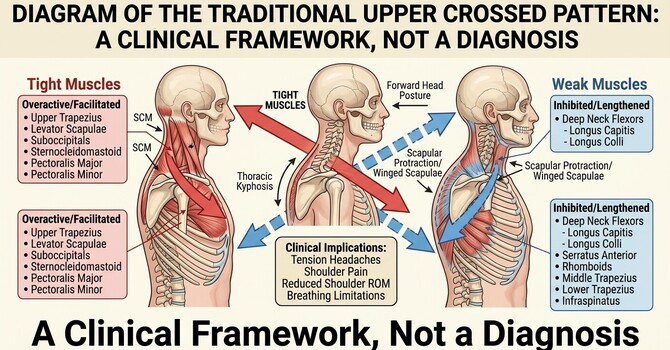
These observations are sometimes discussed through a concept called lower crossed syndrome. The framework can be useful, but it needs to be applied carefully.
What is lower crossed syndrome?
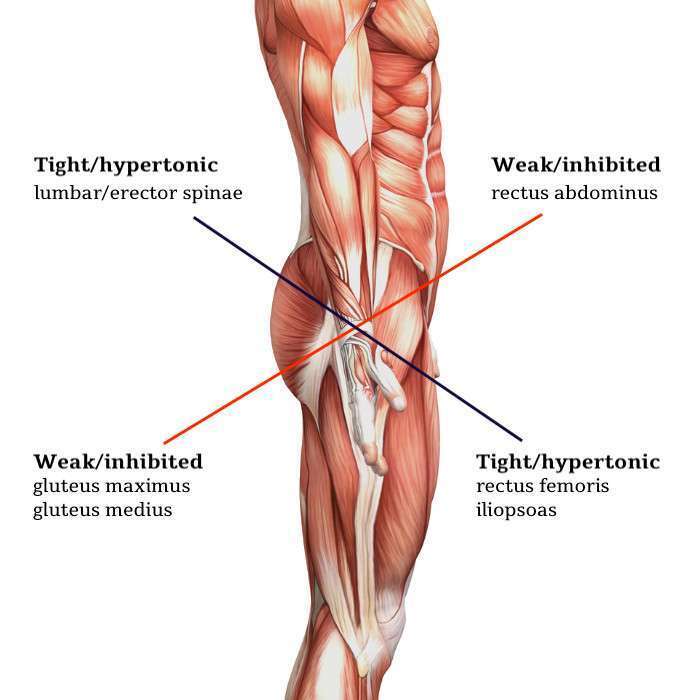
Vladimir Janda's lower crossed pattern describes a proposed relationship between muscles around the pelvis, hips and trunk.
In the traditional model, certain muscles at the front of the hips and in the lower back are described as tending toward increased tension or activity, while abdominal and gluteal muscles may show reduced performance or activation.
The term “crossed” refers to the way these muscle groups are represented in a pattern across the body.
It is a clinical framework for thinking about movement and muscle function, not a diagnosis that can be made from appearance alone.
Does an arched lower back mean something is wrong?
Not necessarily.
People naturally differ in pelvic position, spinal curvature and the way they stand. A visible arch doesn't automatically mean your spine is under harmful stress, and it doesn't establish that you have weak abdominal muscles or tight hip flexors.
The more important question is whether a movement or physical limitation relates to your symptoms or goals.
For example, a person who experiences discomfort during repeated lifting may need an assessment of lifting tolerance, hip movement, trunk strength and the amount of work they're doing. Their standing posture may be relevant, but it shouldn't be assumed to explain the problem.
Why look at the hips and trunk together?
The hips and trunk coordinate during walking, running, squatting, lifting and many everyday tasks.
If hip movement is limited in a particular direction, a person may adapt by changing how the pelvis or spine moves. If trunk endurance is low for the demands of an activity, movement may become more difficult as fatigue builds.
These are possibilities to investigate, not conclusions that can be drawn from a posture photo.
What does a useful assessment involve?
A clinician may examine hip range of motion, trunk strength and endurance, balance, movement control and how you perform the tasks that provoke symptoms.
The assessment should also consider your history. When did the symptoms start? What makes them better or worse? What activities have changed? Are there signs that require medical evaluation?
That information helps determine whether a muscle imbalance is worth addressing and which findings deserve attention.
Do you need to stretch your hip flexors and strengthen your glutes?
Maybe, but not automatically.
If a relevant mobility restriction is found, mobility work may be appropriate. If strength or endurance limits a meaningful task, progressive strengthening may be useful. Some people may benefit from practicing a specific movement, adjusting activity demands or combining several approaches.
The goal isn't to force every person into the same pelvic position. It is to improve the abilities they need.
Build function, not a textbook posture
You don't have to achieve a particular pelvic angle to walk, lift or exercise well.
If low back or hip discomfort is limiting your daily routine, an evaluation at Optimal Health can help determine whether hip mobility, trunk function, strength or another factor is relevant. The plan should be based on your symptoms and functional goals, not just a label.