There is nothing quite like getting back on the course after winter or a long break. The weather improves, the clubs come out, and it feels good to think about teeing off again. But many golfers notice the same thing in those first few rounds: the body does not always feel as ready as the mind.
Maybe your swing feels tight. Maybe your lower back gets sore faster than usual. Maybe your hips, shoulders, or neck feel stiff after just a few holes. That is common, especially after months of less walking, less rotation, and less time doing the movements golf demands.

At Optimal Health, we help golfers across South Jersey prepare their bodies to move better and feel better. If you are getting back to the course in Egg Harbor Township, Turnersville, or anywhere nearby, it helps to understand why golf can be demanding on the body and what you can do before the season starts.
Why Golf Can Stress the Body
Golf may look smooth and controlled, but the swing places a surprising amount of stress on several areas at once. Even a casual round asks your body to rotate, shift weight, stabilize, and repeat the same movement pattern over and over.
Lower back
The lower back often works hard during the golf swing, especially if the hips or middle back are not moving well. When rotation is limited elsewhere, the lower back may try to make up for it. That extra strain can lead to soreness, tightness, or irritation during or after a round.
Hips
Your hips play a major role in weight transfer and rotation. If they feel stiff after a long offseason, your swing may feel restricted. Limited hip mobility can also change your mechanics and place more stress on the knees and lower back.
Shoulders
The shoulders help guide the club through a large range of motion. Tight shoulders can make it harder to rotate comfortably and may affect both backswing and follow-through.
Neck
Many golfers carry tension in the neck without realizing it. Looking down at the ball, rotating through the swing, and repeated upper body tension can all contribute to stiffness in this area.
Core
Your core helps transfer force and control movement. It supports the spine and helps the body stay balanced through the swing. If the core is weak or poorly coordinated, other areas may work harder than they should.
Wrists and elbows
Grip, impact, and repeated swinging can irritate the wrists and elbows, especially if you return too quickly without preparing the body. Golfer’s elbow, tendon irritation, and wrist soreness are all common complaints.
Why Warming Up Before Golf Matters
Many golfers go from the car straight to the first tee. The problem is that golf is not a cold-start activity. The swing requires rotation, balance, coordination, and control. If your body has been sitting all morning, those movements may feel limited.
A warm-up helps increase blood flow, wake up key muscles, and improve joint motion before you swing at full speed. Research has shown that warm-up routines can improve performance and help reduce injury risk in sports that involve power, rotation, and repeated movement. For golfers, even a short warm-up can help the first few swings feel smoother and more comfortable.
Warming up also helps you notice how your body feels that day. If one hip feels tight or your upper back is not rotating well, you can address that before it affects your round.
Key Areas to Focus On
How hip mobility affects the golf swing
Good hip mobility helps you turn, shift weight, and generate force more efficiently. If the hips are stiff, the swing may become shorter or less fluid. That can lead to compensation in other areas, especially the lower back.
For many golfers, the offseason means more sitting and less movement. That often leaves the hip flexors, glutes, and surrounding tissues feeling tight or underactive. Restoring hip mobility can help the swing feel freer and may reduce strain elsewhere.
Why thoracic spine rotation is important
The thoracic spine is the middle part of your back. It plays a major role in rotation. A healthy golf swing depends on the ability to turn through this area without forcing too much motion from the lower back.
If thoracic rotation is limited, golfers often notice they cannot complete their backswing comfortably, or they feel they have to “muscle” the movement. Improving thoracic mobility can help with rotation, posture, and follow-through.
How core strength helps protect the lower back
The core does more than help with fitness. In golf, it helps control rotation and stabilize the spine while the hips and shoulders move around it. A well-functioning core can reduce excess stress on the lower back and improve balance during the swing.
This does not mean you need extreme workouts. Often, simple exercises that improve control, stability, and coordination can make a meaningful difference.
Common Golf-Related Aches and Injuries
Golf-related pain is often linked to mobility limits, repeated movement, or returning too quickly after a break. Some common issues include:
- Lower back tightness after walking or swinging
- Hip stiffness during setup or follow-through
- Shoulder soreness with overhead motion or backswing
- Neck tension after a round
- Elbow pain, especially on the inside of the elbow
- Wrist soreness with gripping or impact
- Mid-back stiffness that affects rotation
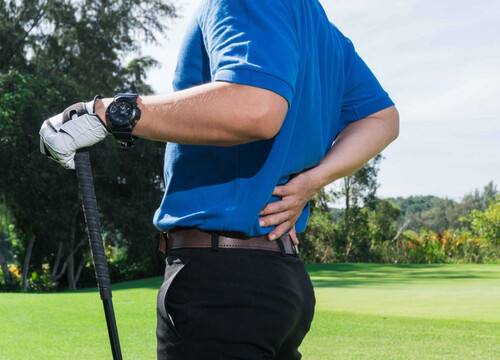
These aches do not always mean something serious is wrong. In many cases, they are a sign that the body is not moving as well as it could or that certain areas are taking on more work than they should.
Simple Warm-Up Habits Before a Round
A golf warm-up does not have to be long or complicated. Before you tee off, a few intentional movements can help your body loosen up, rotate better, and feel more prepared for your swing.
Here are a few warm-up habits Dr. Frank recommends before a round:
Start with upper body rotation
Begin with an open-book style movement to get your upper body moving. Let your eyes follow your hand as you rotate, and aim for about 10 reps in each direction.
Practice rotation in your golf posture
Set up in your 5-iron posture with a club across your shoulders. Use a wall or golf cart for feedback as you rotate, making sure you are not shifting or “cheating” through the movement.
Work through the side that feels stuck
If your backswing or follow-through feels restricted, spend extra time opening up that direction. The goal is to improve rotation without sliding or creating bad habits.
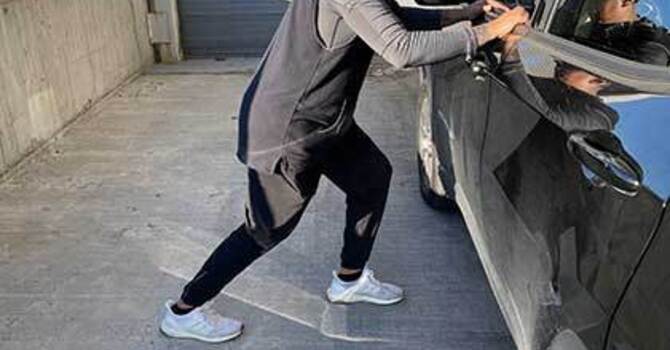
Loosen up your hamstrings and calves
Tight hamstrings and calves can affect your ability to get into position and stay consistent through your swing. Dr. Frank recommends scoop movements for the hamstrings and a calf stretch to finish.
Build into your swing gradually
Once your body feels looser, move into easy practice swings before going full speed. This helps your body feel more ready before your first shot.
Before you head back to the course, Dr. Frank shares a few simple warm-up tips to help your body move better before you swing.
Part 4: Hamstring & Calf Warm-Up
How Optimal Health Can Help
If your body feels stiff, restricted, or sore when you return to golf, a more targeted approach can help. At Optimal Health, we look at how your body moves as a whole. Instead of only focusing on the painful area, we work to identify what may be limiting your swing or overloading certain joints and muscles.
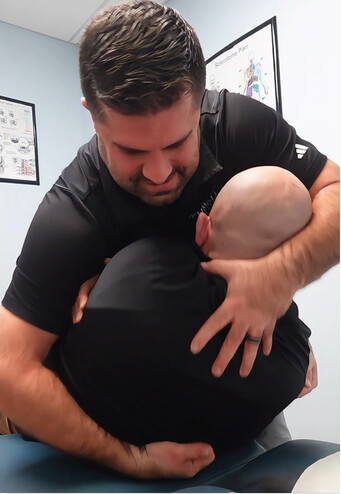
Chiropractic care to improve joint mobility
Chiropractic care may help improve motion in the spine, hips, and other joints that affect the golf swing. When the body moves more freely, rotation often feels easier and less forced.
Physical therapy to build strength and control
Physical therapy can help strengthen the muscles that support your swing, including the core, hips, glutes, and postural muscles. Better strength and control can improve movement quality and help reduce strain.
Movement assessments to identify swing-related limitations
A movement assessment can reveal mobility restrictions, balance issues, or control problems that may be affecting your swing. This helps guide a plan that matches your body’s needs.
Manual therapy or soft tissue work for tight muscles
Hands-on treatment may help reduce muscle tension and improve tissue mobility in tight areas such as the hips, shoulders, neck, and upper back.
Mobility and corrective exercises
Targeted exercises can help improve flexibility, rotation, stability, and movement patterns. These are often some of the most useful tools for golfers getting ready for the season.
Golf-specific guidance for safer movement
At Optimal Health, we can also provide practical guidance for preparing your body for golf, managing soreness, and moving more efficiently on and off the course. Whether you visit us in Egg Harbor Township or Turnersville, our goal is to help you return to the game with more confidence and comfort.
Get Ready for the Season With the Right Preparation
Getting back to golf after a long break does not mean you have to accept stiffness, soreness, or a swing that feels off. With the right preparation, many golfers can improve mobility, move more comfortably, and enjoy the season more.
A short warm-up, better hip and thoracic mobility, improved core control, and the right guidance can go a long way. If stiffness, pain, or limited mobility is affecting your swing, it may be worth taking a closer look at what your body needs.
If you are in South Jersey and want help getting ready for the season, the team at Optimal Health is here to support you. If stiffness, pain, or limited mobility is affecting your swing, let us help you get back to the game you love.