“My back went out. I think I slipped a disc.”
It's a common conclusion.
Sometimes a disc-related problem is part of the clinical picture. Other times, the symptoms may have a different source.
The tricky part is that you usually can't determine the cause simply by where your back hurts.
Why the distinction isn't always obvious
The low back contains discs, joints, muscles, ligaments and nerves that work together.
Pain from different structures can overlap.
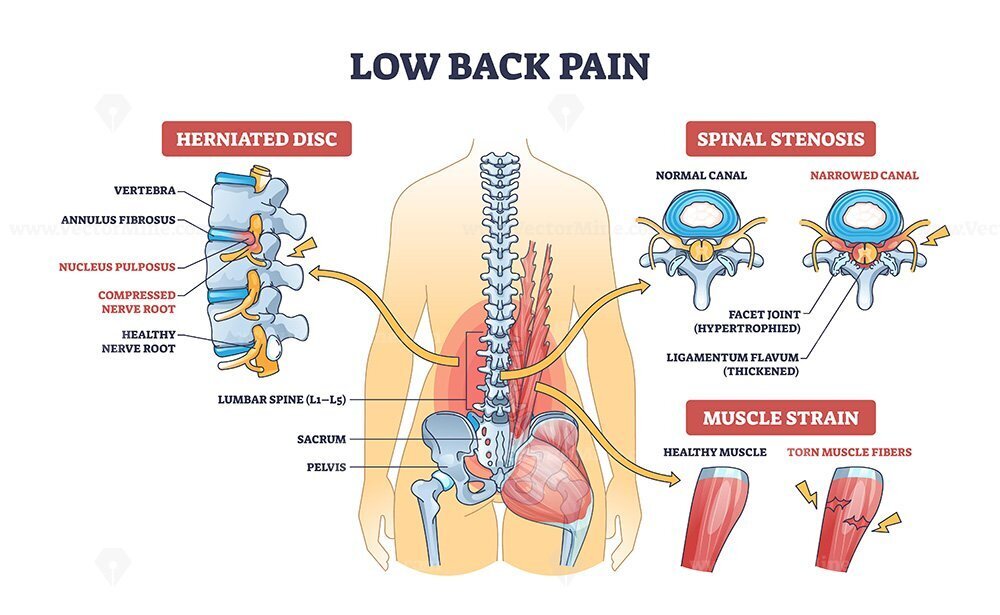
Muscles can become painful after an increase in activity, awkward movement or repetitive loading. Disc-related problems can also produce back pain, and some can irritate nearby nerve structures.
The symptoms can look similar at first.
That's why a clinician considers the entire pattern rather than trying to match one symptom to one structure.
What might make a nerve-related problem different?
When a disc problem affects a nerve root, symptoms may extend beyond the low back.
You might notice pain, tingling, numbness or weakness into the buttock or leg.
But even this doesn't mean that every person with leg pain has a disc problem.
The clinical examination matters.
A clinician may assess sensation, strength, reflexes, movement and how symptoms respond to different positions or repeated movements.
What about muscle pain?
Muscular pain may feel localized, sore or achy and can sometimes be associated with a recent increase in physical demand.
Maybe you lifted more than usual.
Maybe you started a new workout.
Maybe you spent a weekend doing yard work.
But again, there isn't a single symptom that proves “this is muscle pain.”
The body isn't always that simple.
Why movement can provide useful information
Instead of asking only, “Where does it hurt?” a clinician may ask, “What happens when you move?”
Does bending forward increase symptoms?
Does standing or walking change them?
Does a repeated movement make your symptoms better, worse or change where you feel them?
This information can help a clinician develop and test a working hypothesis.
It's not about finding one perfect movement.
It's about seeing how your symptoms behave.
Do you need an MRI to find a disc problem?
Not necessarily.
Imaging can be valuable when there is a clinical reason for it, but guidelines do not recommend routine imaging for uncomplicated low back pain when the result isn't expected to change management.
A clinical evaluation can tell us things an MRI can't, including how you move, what activities aggravate your symptoms, how strong you are and what you need to return to doing.
Don't let the word “disc” automatically scare you
Hearing that a disc is involved can make people think they need to stop moving.
That isn't automatically the case.
Management depends on the individual presentation, symptoms, irritability, neurological findings and activity goals.
The objective is to choose appropriate activity and rehabilitation rather than becoming afraid of movement.
When should you get evaluated promptly?
New or worsening neurological weakness, significant numbness, bowel or bladder changes, saddle-area numbness, major trauma, fever or other concerning symptoms warrant appropriate medical evaluation.
Otherwise, persistent or limiting back pain is still worth evaluating, especially if it's interfering with work, exercise, sleep or the activities you care about.
The bottom line:
You can't reliably diagnose “disc pain” versus “muscle pain” by poking the sore spot.
The better approach is to look at the whole clinical picture and then use movement, examination findings and symptom behavior to guide the next step.