Your head aches, your shoulders feel tense, and your neck is stiff. Is it a tension-type headache, a cervicogenic headache, or something else?
These terms describe different headache types, but their symptoms can overlap. A careful history and examination are more useful than trying to diagnose the headache from one symptom alone.
What is a cervicogenic headache?
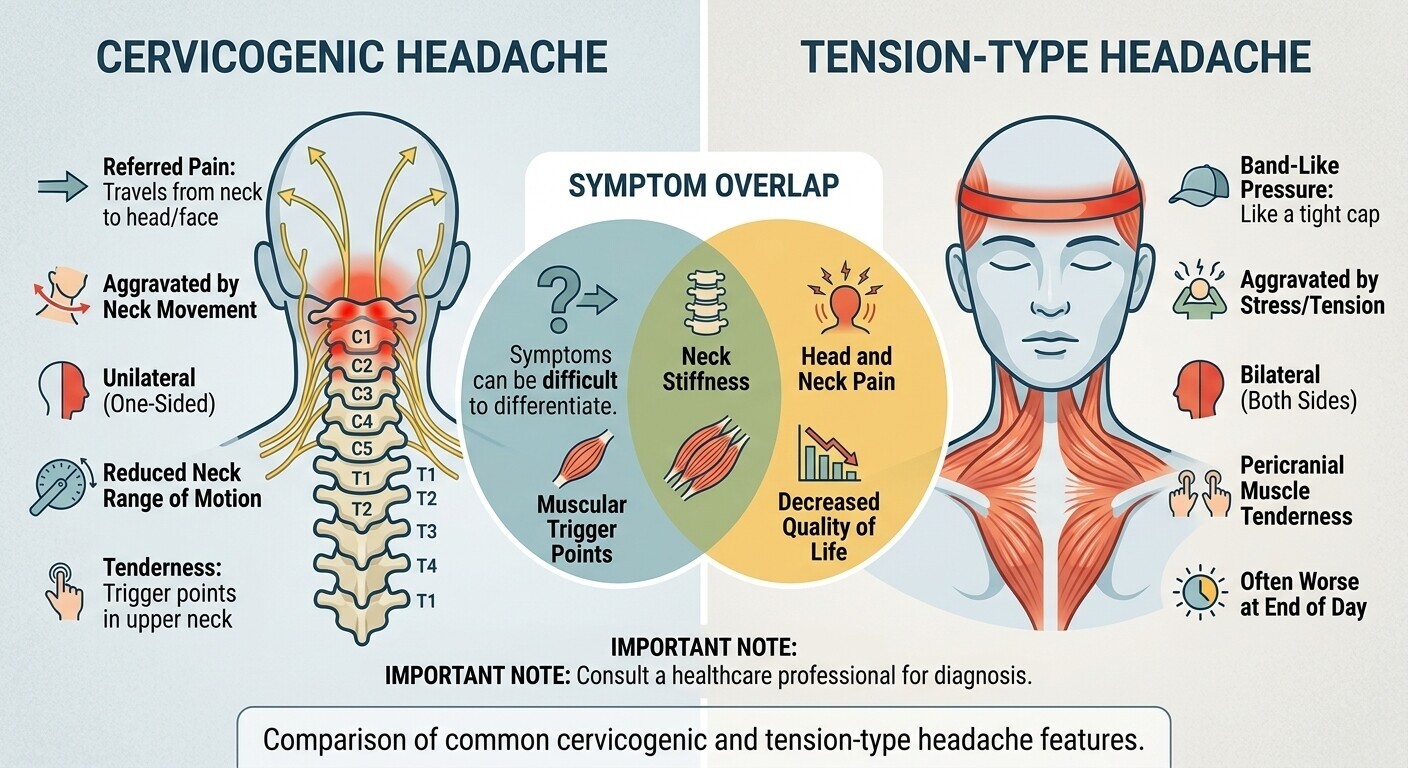
A cervicogenic headache is a secondary headache, meaning it is attributed to a problem in the cervical spine or related structures.
The pain may begin in the neck or back of the head and spread forward. It may be more noticeable on one side, and neck movement or pressure on certain structures may reproduce the familiar headache.
A clinician looks for evidence that a cervical condition is actually contributing to the headache. Neck stiffness alone is not enough to establish that connection.
What is a tension-type headache?
Tension-type headache is a primary headache disorder. It is not simply a headache caused by tight muscles.
The pain is often described as pressing or tightening, commonly on both sides of the head. It is generally mild to moderate and is not typically made substantially worse by ordinary physical activity.
Some people also experience tenderness around the scalp, neck or shoulder muscles. That tenderness doesn't prove that muscle tension is the sole cause.
Why can they be difficult to distinguish?
Both headache types can occur with neck discomfort and tenderness. Some symptoms also overlap with migraine, which can include neck pain or stiffness.
A clinician considers the overall pattern: how the headache began, where it occurs, how long it lasts, how often it happens, associated symptoms and what influences it.
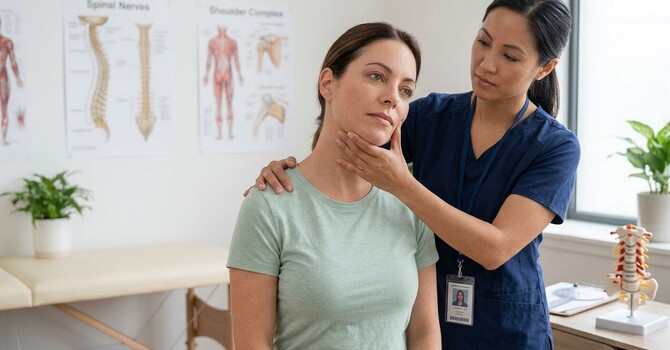
A musculoskeletal examination may help identify relevant neck-related findings, but it cannot independently rule out every other headache disorder.
Does the distinction change treatment?
It can.
For a confirmed cervicogenic headache, selected neck exercises and manual therapy may be considered as part of an individualized plan. For tension-type headache, exercise, education and other approaches may be useful depending on the person's needs and headache pattern.
Research supports some physical therapy approaches for cervicogenic headache, but the certainty of evidence differs across treatments and outcomes. It doesn't establish one universally effective technique. <Cite refs={["turn334711search1","turn334711search8"]} />
People with frequent or disabling headaches may also benefit from evaluation by a medical professional to discuss headache-specific treatment and management.
When should you look beyond the neck?
A sudden severe headache, new neurological symptoms, fever with marked neck stiffness, or a new headache after significant trauma needs urgent assessment. Headaches that are becoming more frequent, changing substantially or interfering with daily life also deserve medical attention.
Start with the right question
Instead of asking only which muscle is tight, ask what type of headache pattern you may be experiencing and what evidence supports that explanation.
At Optimal Health, we can assess relevant neck movement and musculoskeletal function when appropriate. If your symptoms suggest a primary headache disorder or another medical cause, the next step may involve a medical evaluation or coordinated care.