You turn your head to check behind you, look up toward a shelf or try to sit comfortably through a long meeting. Your neck feels stiff, and stretching it provides only temporary relief.
Could your upper back be part of the picture?
Sometimes, yes. The neck and upper back work together during many movements, although upper-back stiffness isn't automatically the cause of neck pain.
How are the neck and upper back connected?
Your cervical spine supports and moves your head. Just below it, the thoracic spine forms the upper and middle portion of your back and connects with the rib cage.
When you turn your body to look behind you, reach overhead or rotate during sport, movement can come from both the neck and the upper back, along with other parts of the body.
The amount each region contributes varies with the task and the person.
If movement in one area is limited or uncomfortable, you may adjust how you move elsewhere. That adjustment isn't automatically harmful, but it can be worth examining if it affects symptoms or function.
Does upper-back stiffness cause neck pain?
Not in every case.
Some people have reduced upper-back movement without pain. Others have neck discomfort despite having adequate upper-back mobility. Symptoms can also reflect several contributing factors rather than one restricted joint or muscle.
An assessment helps determine whether upper-back movement is relevant to the specific problem.
For example, if turning your head and upper body together feels easier than turning your head alone, that response may be useful information. It doesn't prove the upper back is the source, but it can help guide further examination.
What might an evaluation include?
A clinician may assess neck rotation, upper-back movement, shoulder mobility and how these areas contribute to a task that matters to you.
If you struggle to look over your shoulder while driving, the assessment may focus on comfortable rotation and the limitations affecting that activity. If reaching overhead causes symptoms, shoulder and upper-back function may also deserve attention.
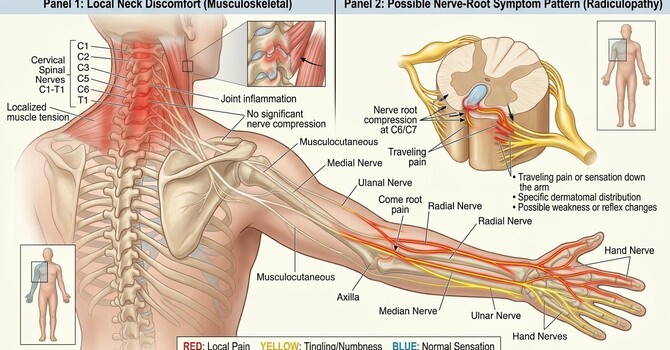
Your history matters as well. The clinician will want to understand when the symptoms started, how they behave, whether they travel into the arm and whether there are signs of nerve involvement or another condition that needs medical evaluation.
What can treatment involve?
If upper-back mobility is a relevant limitation, comfortable mobility exercises may be useful. If strength or endurance is affecting a task, progressive exercise may be more appropriate. Some people may benefit from a combination of movement practice, strengthening, activity changes and hands-on care when indicated.
The plan should be based on the examination and reassessed as your symptoms and function change.
There is no need to force the upper back to move more simply because it feels stiff. More movement isn't always the goal; the goal is to have enough comfortable movement for the activities you need to perform.
Look at how the regions work together
Your neck doesn't function in isolation. At the same time, not every neck complaint requires treatment of the upper back.
At Optimal Health, we consider the relationship between the neck, upper back and shoulders when the findings suggest it may be useful. If stiffness is affecting driving, exercise, work or everyday movement, an evaluation can help clarify which limitations matter and what may help you move more comfortably.