You reach for something on a high shelf and feel pain around the shoulder. Later, your neck feels stiff. Or perhaps your shoulder aches even though the discomfort seems to begin near the base of your neck.
Which area is actually causing the problem?
It isn't always obvious. The neck and shoulder work together during many movements, and symptoms in one region can sometimes be felt in the other.
Why the location of pain can be misleading
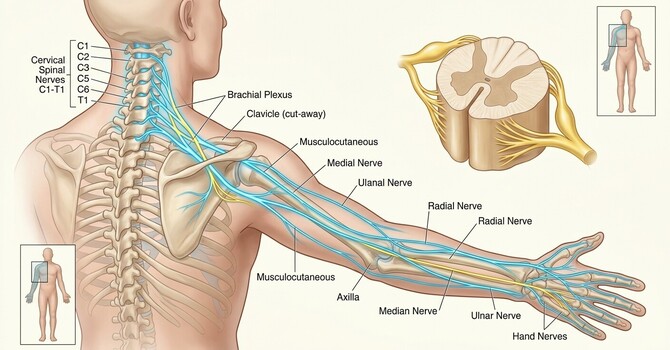
Your neck contains joints, muscles, discs and nerves that contribute to head and neck movement. Your shoulder includes the shoulder joint, rotator cuff, shoulder blade and surrounding tissues.
These structures are different, but their functions overlap.
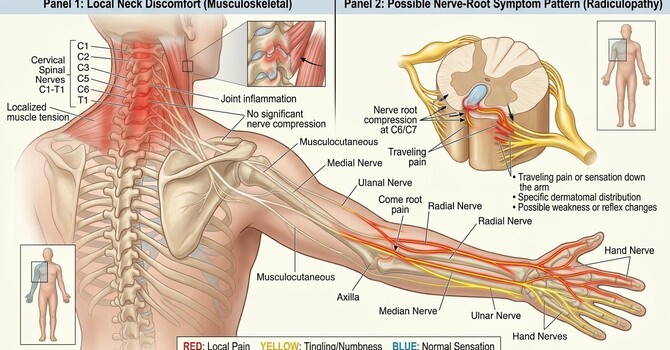
For example, turning your head, reaching overhead and carrying a bag all require coordination between multiple body regions. Symptoms can arise from structures in the neck, the shoulder itself, or more than one contributing factor.
Pain near the shoulder doesn't automatically mean the shoulder is injured. Similarly, neck tightness doesn't prove that the neck is the only source of discomfort.
What movements bring on the symptoms?
The way your symptoms respond to movement can provide useful information.
If turning or tilting your neck changes the pain around your shoulder, a clinician may investigate whether the neck is contributing. If reaching overhead, lifting an object or moving your arm behind your back reproduces the pain, the shoulder needs careful examination.
These are clues, not stand-alone diagnostic tests. Some people have symptoms during both neck and shoulder movements.
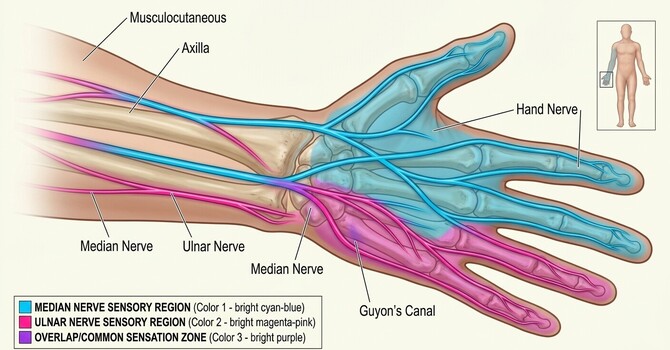
Other details matter, too. Does the pain travel below the elbow? Is there tingling or numbness? Do you notice weakness, or is movement limited because it hurts? Did the problem start after an injury, or did it develop gradually?
Those answers help determine what to examine next.
Why the assessment should include both areas
A useful evaluation may examine neck movement, shoulder range of motion, strength, shoulder-blade movement and the response to specific tasks. If symptoms suggest nerve involvement, a clinician may also assess sensation, muscle strength, reflexes and other neurological signs.
The purpose isn't to test everything indiscriminately. It's to select examination findings that help distinguish between possible explanations.
Imaging isn't automatically necessary just because neck and shoulder symptoms overlap. The decision depends on the history, examination findings and whether there are reasons to suspect a condition that requires further medical investigation.
What if both areas contribute?
Sometimes the answer isn't simply neck or shoulder.
A person may have a shoulder limitation that changes how they move, alongside neck discomfort that makes reaching more difficult. Another person may have neck-related symptoms that are aggravated by particular arm positions.
Care should reflect the findings rather than force every case into one category.
Depending on the assessment, a plan may involve shoulder or neck mobility, progressive strengthening, movement retraining, activity modification or other appropriate conservative approaches.
Don't diagnose yourself by pointing to the pain
The spot that hurts matters, but it isn't the whole story. What you can and cannot do, which movements change the symptoms, and whether there are neurological signs all help guide clinical reasoning.
If neck or shoulder pain is interfering with reaching, lifting, sleeping or exercise, Optimal Health can evaluate how these regions are functioning together and help determine an appropriate next step.