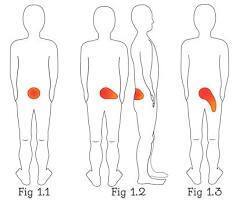
Imagine you have pain traveling from your low back into your leg.
Then you perform a particular movement and something interesting happens.
The leg pain becomes less noticeable, while more of the discomfort is felt closer to your back.
That change may be clinically meaningful.
It's called centralization.
The opposite pattern, when symptoms move farther away from the spine and more into the buttock or leg, is often called peripheralization.
These terms come from the way clinicians observe symptom behavior during movement assessment.
What is centralization?
Centralization describes a change in symptoms where pain that was felt farther down the limb moves toward the center of the body, often becoming more concentrated around the back.
It isn't simply “the pain got better.”
The location of the symptoms changes.
For example, someone might begin with pain in the calf and buttock. After a particular movement, the calf pain disappears while some back discomfort remains.
That movement of symptoms toward the center is what clinicians refer to as centralization.
Research has found centralization and directional preference to be clinically useful indicators of prognosis in low back pain, although they don't occur in everyone and shouldn't be treated as a universal treatment rule.
What is peripheralization?
Peripheralization describes the opposite direction.
Symptoms that were more centralized may begin traveling farther into the buttock or leg with a particular movement or position.
That doesn't automatically mean you've damaged something.
It means the symptom response is providing information.
A clinician can use that information to decide whether a particular movement or exercise is appropriate for that individual.
Why does the direction matter?
Pain intensity is useful.
But location can provide another layer of information.
Imagine two people who both rate their pain as a 5 out of 10.
For one person, the pain is only in the low back.
For another, the pain reaches into the foot.
Those are different clinical presentations even though the numerical pain score is identical.
Similarly, if a movement changes where the symptoms are felt, that response can help a clinician understand the person's presentation.
This isn't about finding a magic exercise
Centralization doesn't mean there's one movement that “fixes” your back.
And peripheralization doesn't mean a movement is permanently forbidden.
The goal is to understand the response.
Sometimes a clinician may use repeated movements to see whether a directional preference exists.
A 2025 systematic review found low- to moderate-certainty evidence that the McKenzie Method can provide clinically important improvements for some people with chronic low back pain and a directional preference, while also finding that the evidence is not strong enough to suggest it is universally superior to every other approach.
That's a useful distinction.
The method is a tool.
The patient's response is what helps determine whether the tool fits.
What if your symptoms move farther down your leg?
Don't automatically panic.
But don't ignore a meaningful change either.
If a movement consistently increases your leg symptoms, especially numbness, tingling or weakness, that's worth discussing with a qualified clinician.
The appropriate response depends on the full clinical picture.
Why this matters at Optimal Health
A movement-based evaluation isn't about making you perform exercises just because they're popular.
It's about observing what your body does.
How do your symptoms respond?
How does your movement change?
What happens when we modify the task?
What does that tell us about the next step?
That's clinical reasoning.
And it's one reason two people with “sciatica” may receive very different recommendations.