Your hand feels numb, your fingers tingle or you notice weakness when gripping an object. The next question is often: which nerve is involved?
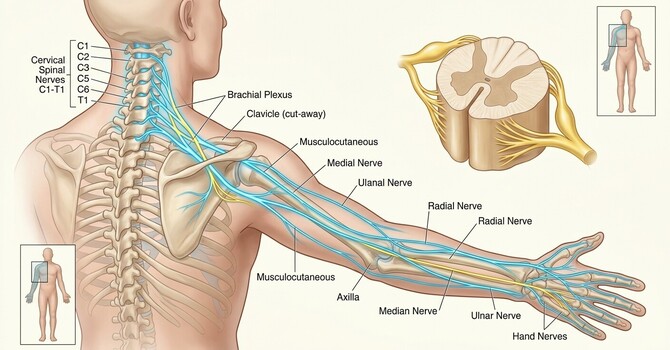
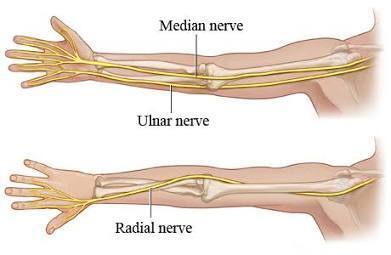
Three major nerves supply much of the arm and hand: the median, ulnar and radial nerves. Each follows a different route and contributes to different movements and areas of sensation.
Knowing their general pathways helps explain why symptoms may appear in different places. It doesn't mean you can identify the affected nerve from symptoms alone.
The median nerve
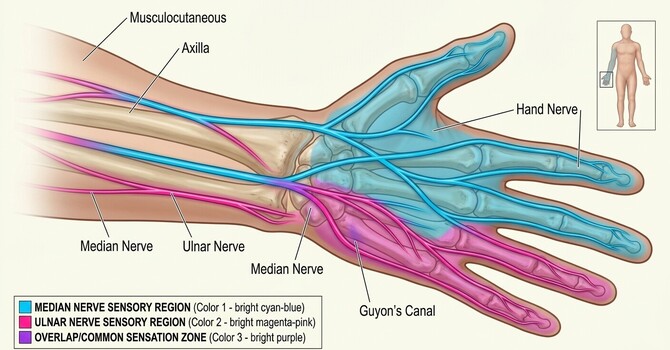
The median nerve travels through the arm and forearm and passes through the carpal tunnel at the wrist.
It contributes to sensation in the thumb, index finger, middle finger and part of the ring finger, and it supplies several muscles involved in thumb and hand function.
When the median nerve is affected at the wrist, as in carpal tunnel syndrome, symptoms may include tingling or numbness in parts of the hand, sometimes worse at night. Some people also experience weakness or difficulty with thumb-related tasks.
However, similar symptoms can have other explanations. The location, timing and examination findings help distinguish them.
The ulnar nerve
The ulnar nerve travels behind the inside of the elbow before continuing into the hand. It supplies sensation to the little finger and part of the ring finger and contributes to several muscles important for fine hand control.
Because the nerve passes through a relatively confined area near the elbow, prolonged elbow bending or pressure around that region can aggravate symptoms in some people.
Ulnar nerve symptoms may include tingling in the little finger and adjacent part of the ring finger, reduced hand coordination or weakness. A clinician will consider whether the symptoms fit the nerve's pathway and whether the neck or another area could also be involved.
The radial nerve
The radial nerve travels along the arm and contributes to sensation in part of the back of the hand, as well as the muscles that straighten the wrist and fingers.
Depending on where the nerve is affected, symptoms can include pain, altered sensation or difficulty extending the wrist or fingers.
The exact presentation varies. Not all radial nerve problems cause the same symptoms, and weakness can have other causes that require examination.
Why the pathway matters
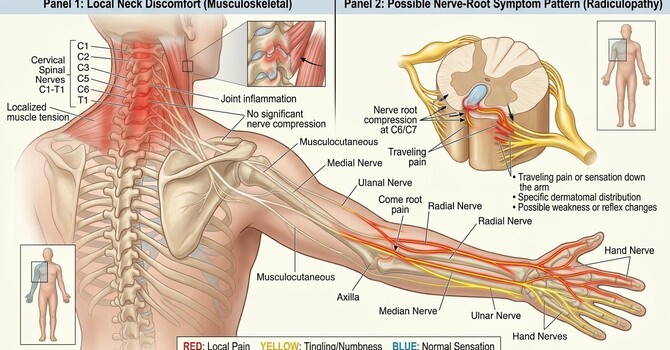
Nerves can be affected at different points along their route. Symptoms that resemble one another may originate near the neck, around the elbow or at the wrist.
For example, hand tingling doesn't automatically mean carpal tunnel syndrome. A clinician may need to examine the neck, arm and wrist to determine which explanation best fits the findings.
The assessment may include strength, sensation, reflexes, neck and limb movement, and selected nerve provocation tests. These tests help build a clinical picture; no single test should be treated as definitive in every case.
What should you do if symptoms persist?
Avoid assuming that every nerve symptom needs the same stretch or exercise. The appropriate approach depends on which nerve may be involved, the severity of symptoms and whether strength or coordination is changing.
Persistent numbness, worsening weakness or loss of hand coordination warrants medical assessment. Sudden neurological symptoms, particularly one-sided weakness with speech or facial changes, require emergency care.
A more specific assessment can lead to a more appropriate plan
If hand or arm symptoms are affecting work, lifting, typing or everyday tasks, an evaluation at Optimal Health can help examine the neck and upper extremity together.
The goal is to understand which findings matter, identify when referral is needed and avoid treating a nerve pathway based on assumptions alone.