.jpg)
You have been showing up. You have been doing the exercises. You have given it time. And you are still hurting.
That is one of the most frustrating places to be in recovery. You did what you were supposed to do, and you are not seeing the results you expected. It is natural to start wondering if something is wrong with you — or if things are ever going to get better.
Here is what we want you to know: still being in pain does not mean you are broken. It does not mean physical therapy cannot help you. Most of the time, it means one thing: something in the plan may need a second look.
At Optimal Health, we work with patients across South Jersey who feel exactly this way. Some have been in treatment for weeks. Some have tried multiple approaches. And many of them find that once the right pieces are in place, they finally start to move forward.
Physical Therapy Works — So What Happens When It Does Not?
Physical therapy is a well-supported approach to pain, injury, and movement problems. For many people, it is highly effective. But PT is not a single formula that works the same way for everyone.
What matters is what is happening inside the treatment. How thorough was the initial assessment? Are the exercises matched to your specific restrictions? Is the plan progressing as you improve? Are all the contributing factors being addressed?
When those questions do not have clear answers, progress can stall — even when someone is putting in the effort.
What May Be Missing?
Exercises are an important part of getting better. But they are only one part of recovery. If other key pieces are missing, pain can keep coming back even when you are working hard.
Here are some of the most common gaps we see:
1. A thorough movement assessment
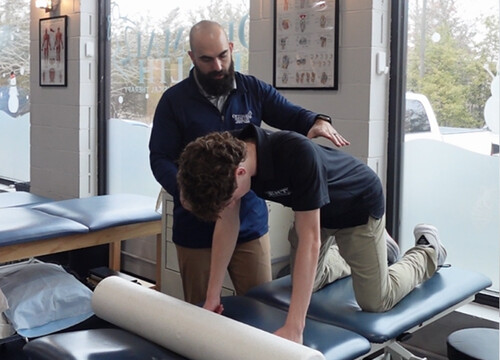
Understanding pain starts with understanding how you move. If an assessment only looks at the area that hurts, it may miss the movement patterns, compensations, or restrictions that are driving the problem in the first place. A comprehensive look at how your body moves together gives a much clearer picture of what is actually going on.
2. Identifying the true source of pain
Pain is a signal, but it does not always point directly to the source. The place where you feel discomfort is not always where the problem originates. Knee pain can come from the hip. Neck tension can connect to how the upper back moves. Shoulder pain can relate to restricted thoracic mobility. When treatment focuses only on the spot that hurts, the actual cause may go unaddressed.
3. Addressing joint restrictions
If a joint is not moving the way it should, the muscles around it compensate. Over time, those compensations create tension, fatigue, and pain in areas that seem unrelated to the original problem. Restoring normal joint motion is often a critical step that exercises alone cannot accomplish.
4. Addressing soft tissue restrictions
Tight muscles, fascial restrictions, and scar tissue from old injuries can all limit movement and contribute to pain. These are physical restrictions that may need hands-on treatment to improve. If soft tissue is not addressed, movement stays limited and the same areas continue to get overloaded.
5. Progressing the treatment plan over time
Your body changes as you recover, and your treatment plan should change with it. If the exercises you started with in week one are still the same ones you are doing in week eight, the plan may not be keeping pace with where you are. A good plan evolves based on how you respond.
6. Considering posture, work demands, daily habits, and activity levels
What happens outside the treatment room matters just as much as what happens inside it. Long hours at a desk, repetitive work tasks, poor sleep positions, high stress, or returning to activity before the body is ready can all keep symptoms from settling down. If these factors are not part of the conversation, pain can persist even when the exercises are solid.
7. Using a more integrated approach when exercises alone are not enough
For some people and some conditions, exercises alone are not enough to break the cycle of pain. When joint mobility, soft tissue tension, and poor movement patterns are all contributing, a more complete plan that addresses each of those layers often produces better results than any single approach on its own.
Looking Beyond the Pain
At Optimal Health, we understand how frustrating it can be to keep showing up for treatment and still feel like you're not making the progress you expected. In many cases, the issue is not a lack of effort—it may be that an important piece of the puzzle has not been addressed.
Pain is often influenced by more than one factor. A painful shoulder may be connected to limited upper back mobility. Persistent knee pain may be influenced by hip weakness. Recurring back pain may be related to movement patterns, joint restrictions, or soft tissue limitations elsewhere in the body.
That's why we take a comprehensive approach. Instead of focusing only on where it hurts, we evaluate how your entire body moves. We look at joint mobility, muscle function, movement patterns, posture, soft tissue restrictions, strength deficits, and the daily activities that may be contributing to your symptoms.
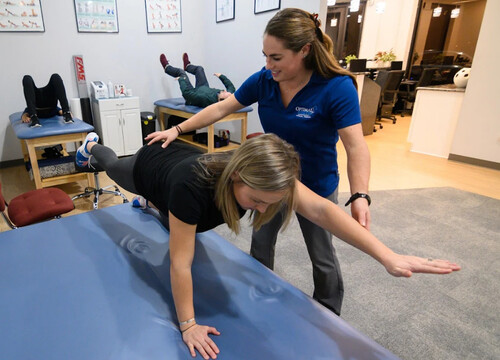
Depending on your needs, treatment may include physical therapy, chiropractic care, manual therapy, Active Release Technique (ART), Graston Technique, Shockwave Therapy, corrective exercises, and mobility training.
Our goal is not simply to help you manage pain. Our goal is to identify what may be limiting your progress, address the underlying causes of your symptoms, and help you get back to doing the things you enjoy with greater confidence and less discomfort.
Feeling Stuck Is Not the End of the Story
If you have been going to physical therapy and are still in pain, that experience is worth taking seriously. It is a signal that something in the current approach may not be the right fit for your situation — and that a more complete plan might make a real difference.
Recovery is not always linear, but it should be moving in a direction. If it is not, it may be time for a fresh set of eyes and a more thorough evaluation.
If you feel stuck, Optimal Health is here to help. Schedule an evaluation with our team and let us take a closer look at what may be missing from your recovery plan. You do not have to keep living with pain that has not been fully explained or addressed.