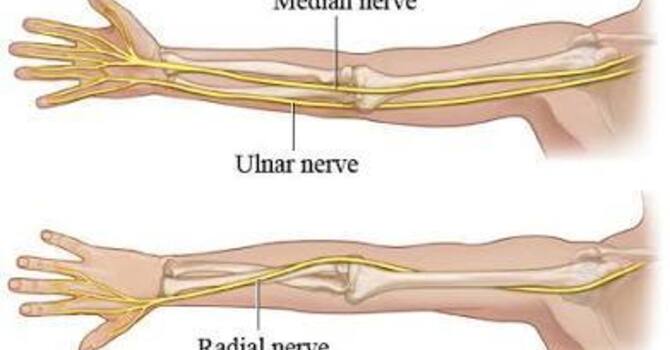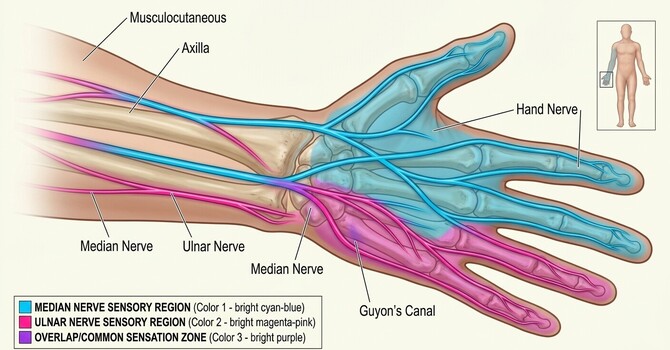
Straighten your elbow, extend your wrist and move your arm away from your body. Depending on your position, you may feel a stretch or pulling sensation along the arm.
That sensation doesn't automatically mean your nerve is damaged or dangerously tight. But the way symptoms respond to movement can sometimes help a clinician understand nerve-related complaints.
This is where neurodynamics comes into the discussion.
What does neurodynamics mean?
Neurodynamics refers to how the nervous system responds to mechanical forces and movement.
Nerves aren't rigid cables that stay in one position. As you move, they can glide relative to surrounding tissues and experience changes in tension and pressure. The nervous system must accommodate these changing demands while continuing to transmit information.
For example, reaching overhead, straightening your elbow or turning your neck can change the mechanical demands placed on nerves traveling through the upper extremity.
What is a neurodynamic test?
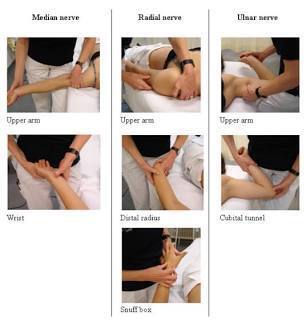
A clinician may use a series of controlled movements to examine how symptoms respond when the nervous system is placed under different mechanical demands.
These tests can involve combinations of shoulder, elbow, wrist and neck movement. The clinician observes whether familiar symptoms appear, how the response changes when a movement is modified, and whether the findings fit the rest of the examination.
A positive response does not automatically prove that a nerve is compressed or damaged. These movements also load muscles and other tissues, so results need to be interpreted alongside the person's history and neurological findings.
What are nerve glides or nerve sliders?
Nerve sliders are exercises designed to encourage movement of the nervous system relative to surrounding tissues while managing how much tension is applied at different points.
They are sometimes included in rehabilitation for selected nerve-related conditions. But they aren't a universal solution for every sensation of tightness in the arm.
The appropriate exercise, range and dosage depend on the presentation. If an exercise causes symptoms to intensify or persist, it may need to be modified or stopped pending assessment.
Does the evidence support neurodynamic treatment?
Research suggests that neurodynamic techniques may be useful as part of a broader treatment plan for some people with nerve-related neck and arm symptoms. The evidence is not strong enough to treat them as a guaranteed solution.
A 2024 systematic review of seven trials found that adding neural mobilization to routine physical therapy improved mobility compared with physical therapy alone, but did not show a clear additional benefit for pain. A 2025 systematic review also reported possible benefits in selected patients while rating the certainty of evidence as low to very low. (2024 systematic review; 2025 systematic review)
That supports a measured approach: use neurodynamic techniques when the examination suggests they may be relevant, and reassess whether they help.
Why the whole assessment still matters
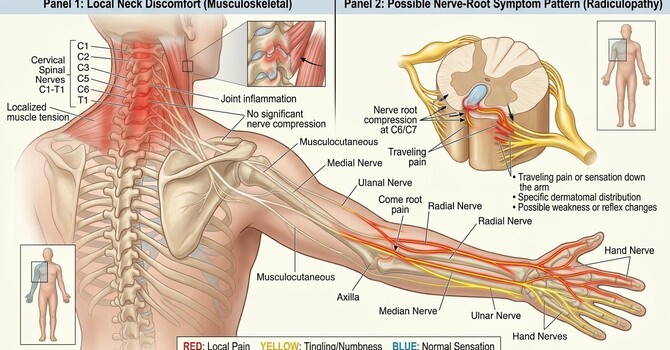
Arm tingling or pain can be related to the neck, a peripheral nerve, the shoulder or other factors. Neurodynamic testing is only one part of the clinical picture.
A clinician may also assess neck movement, muscle strength, sensation, reflexes and how symptoms behave during everyday tasks. Progressive weakness, significant loss of coordination or other concerning neurological signs may require medical investigation rather than exercise alone.
The goal is better function, not a perfect nerve stretch
If arm symptoms make it difficult to type, lift, work or exercise, the goal is to understand the cause and choose a plan that matches your needs.
At Optimal Health, an evaluation can help determine whether nerve-related movement testing or exercises are appropriate and how they fit with other care. You don't need to stretch harder to make a nerve “looser.” You need an approach that respects your symptoms and helps you move toward your goals.